
Silver jewelry from Native American artisans
May 2026
Good Eye
Silver jewelry from Native American artisans
by Peggy Whiteneck
Most Native American jewelry consists of silver with natural stone or shell insets. However, those purchasing it should be aware that Native American jewelry has been widely imitated by non-Native sellers; for those who care about authenticity and artisanal craftsmanship, my advice is to buy from Native American artisans and sellers directly. Such work will be signed in the metal. Native silversmith families often consist of multiple generations working in the field.
Native American jewelry has been available through auctions and other sales venues for centuries. Most of what is readily and affordably available is of mid-to-late 20th century vintage. The forms artists mostly favor are bracelets, rings, and necklaces — for the latter, squash blossom necklaces being a favorite. These necklaces consist of a multiple string of stone medallions culminating in a large medallion at the base of the necklace.
This column focuses on the three main groups of Native American nations, among whom I’ve chosen just a few of the most famous (For those not familiar with the terminology, what white folks used to call “tribes” are called nations today because, by treaty, they have separate national status within U.S. boundaries – a country that, after all, was completely theirs before European settlers arrived).
Navajo jewelry
Wil Vandever was the fourth eldest of 17 (!) children in his family. He learned the art of silversmithing from his wife, Cora, whose name he adopted as his own middle name. His work used high-grade stones. It was especially valued in Japan, and much of his work went there. Vandever died in 2018 at the age of 67 after a five-year battle with colon cancer. As with most Native silversmiths, the family’s silverwork remains multi-generational. One of the characteristics of his heirs’ work is use of a variety of different colored stones.
Robert Kelley is not as generally well-known as some other Navajo silversmiths though his work won several awards. He worked in a variety of designs on rings, pendants, and bracelets, often using feather motifs. His signature in silver is just his name, “Robt Kelley.’ He died in 1991.
Hopi jewelry
The Hopi nation in North Central Arizona is devoted to pacifism. Hopi artisans are best noted for their overlay designs hand carved directly into the silver and without stones. Eventually, the inner layer of the design develops a dark patina that contrasts with the rest of the silver. These designs are often intricately carved into everything from rings to bracelets to concho belts. Hopi silversmiths usually sign their work with pictographs rather than letters. These include, among others, Marcus Lomayestewa, Ricky Coochwytewa, and Bradley Gashwazra (signing with the initials BG rather than a pictograph). Hopi culture is also noted for its pottery and kachina dolls.
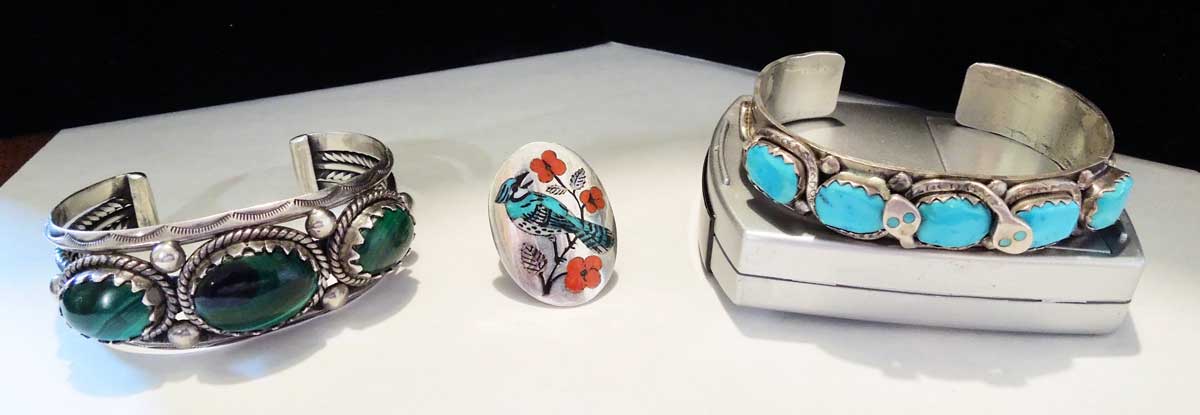
Native American jewelry
Left to right: Native American silver cuff bracelet with malachite green stones, signed Zuni silversmith A. Tennison; inlaid turquoise blue jay and coral blossoms ring by Nancy Haloo, signed with initials NH; turquoise stones set in silver bracelet in Effie Calavaza’s hallmark snake design with inlaid eyes, signed by R & J Calavaza and Effie C. Zuni. (Image courtesy of the author)
Zuni jewelry
The Calavaza family is one of the most famous Zuni silversmith clans. Effie and her husband Juan Calavaza worked together. Prior to Juan’s death in 1970, their work was signed Juan C. Zuni. After his death, her work was signed Effie C. Zuni. A hallmark of her work is snake designs (associated in Zuni culture with healing and transformation) with inlaid stone eyes. She started working in the 1950s and is today of advanced age, having passed her designs down to her silversmith daughters.
Nancy Haloo is another Zuni silversmith from the early 1970s, signing her first work just with her initials NH. Her favored style was inlays, often featuring birds. She learned the craft from her father. She married Ruddell Laconsello in 1976, and thereafter took the name Nancy Haloo Laconsello. Ruddell was also a silversmith, and their later work is his in the metal and hers in the inlay. Later pieces are marked RNL (initialed for Rudell and Nancy Laconsello).
Pricing
Native American silver jewelry can cost anywhere from a few hundred dollars to two or three thousand. You may still be blessed to find for less a great signed piece on the secondary market.
Peggy Whiteneck is a writer, collector, and dealer living in East Randolph, VT. If you would like to suggest a subject that she can address in her column, email her at allwritealready2000@gmail.com.
Don’t get tangled in the Web
June 2024 Good Eye Don’t get tangled in the Web by Peggy Whiteneck Most dealers will come across items for possible acquisition that we haven’t seen before and about which we may know little or nothing – beyond perhaps a gut intuition that it’s something special or…
Collecting for teetotalers
May 2024 Good Eye Collecting for teetotalers by Peggy Whiteneck The history of tea and its dispersion is not entirely known nor clearly understood, but it appears the first tea appeared in China at least as early as 350 BC. Eventually, tea drinking would expand across…
Tips for selling antiques for greater success
April 2024 Good Eye Tips for selling antiques for greater success by Peggy Whiteneck Antique buyers have more types of buying options today than they did 15 or 20 years ago. The Internet and online auctions have revolutionized the antiques trade. However, that also…
Collecting Japanese Kutani and Satsuma Wares
March 2024 Good Eye Collecting Japanese Kutani and Satsuma Wares by Peggy Whiteneck I generally prefer collecting Japanese to Chinese antique pottery and porcelain. This is because, in China, the practice of honorifics, in which late items are marked as being from…
Celebrating American Stretch Glass
February 2024 Good Eye Celebrating American Stretch Glass by Peggy Whiteneck This year, the American Stretch Glass Society celebrates its 50th anniversary (stretchglasssociety.org). The group holds an annual convention and show, this year scheduled for Aug. 15-17 at…
Kitchenware in the hearth and heart of the house
December 2023 Good Eye Kitchenware in the hearth and heart of the house by Peggy Whiteneck Old kitchenware, from pots and pans to small utensils such as mixing spoons, large draining spoons, jar openers, egg beaters, and so on, is not only an affordable option for…