
Laying down a Tile

September 2025

Good Eye

Laying down a Tile

by Peggy Whiteneck

Wall tiles aren’t just an antique decorative accent but a treat for modern collectors. They have a long history: Ancient tiles were being used for paving various surfaces as early as centuries before Christ. But most of the oldest wall tiles seen today date from the 1880s and have become collectible in their own right as well as sought after for home décor. Some older tiles were made of metal, but collector interest today is focused on the ceramic tiles. They were originally used as backing behind stove pipes, as flooring, or as decorative accents in hallways or around doors. These inlaid tiles were described using the adjective “encaustic.” As described on Giovanni’s Tile Design web site, giovannistile.com/blog/the-history-of-decorative-tiles, encaustic tile combines a plain clay base with a stamped area that is filled with colored liquid clay and fired to fuse the different layers together. These encaustic figural art motifs are the tiles of most interest to collectors today.

Antique ceramic tiles were usually about a half inch thick vs. a quarter inch for modern tiles. Still, the thicker width of old tiles did not protect them from damage; it is often difficult to find undamaged tiles today, especially sets of matching older tiles for contemporary home renovation projects. Damage could happen over time while the tiles were in place, or they could be damaged in the process of dismantling and removing them. Tiles taken directly from walls will often have on their backs the cement used to install them, which prevents identification of the maker’s mark and patent and pattern numbers that are usually included on the backs of the original tile. Collectors prefer clean backs that reveal these manufacturing details.

Manufacturers Worldwide and Close to Home

Decorative tiles were a worldwide manufacturing phenomenon. Most of the more famous tile manufacturers were based in the United States, England, Portugal, Morocco, and Japan. Over time, the term “Moroccan” has been used to denote a style rather than a point of origin. But the most famous and original Moroccan tile maker is Zellig, which was actually founded in Morocco and has been functioning for centuries right up until today.

Perhaps the most famous of American decorative tile companies was the J. & J.G. Low Co., founded in Chelsea, MA, in 1877; it closed in 1902. Other American companies founded in the late 1880s included the American Encaustic Tiling Co. in Zanesville, OH (which later morphed into the Shawnee Co.) and Grueby Faience Co. in Revere, MA (closed in 1921). The backs of American Encaustic tiles are marked simply with the company’s initials A.E. (An English company called Alfred Meakin from the 1920s is also marked simply with initials A.M. The use of just the initials may seem to us today a bit of braggadocio by companies so proud of their work they didn’t even have to use the whole name, but it’s more likely that early tile making was restricted to just a few companies, making the use of the initials more readily identifiable at the time).
 

Coudersport Duck on Nest

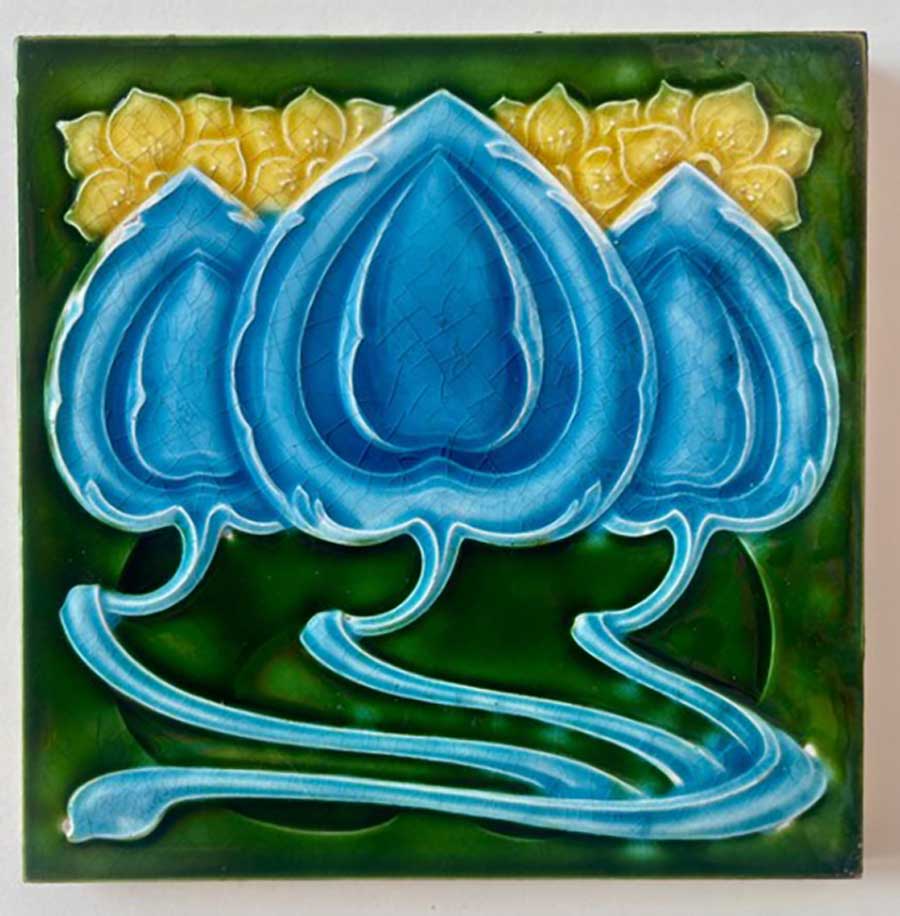
This Alfred Meakin wall tile sold on eBay in July for $200. It is marked on the verso AM LTD ENGLAND. Meakin also made border tiles for outlining room surfaces that are sought-after collectibles today. Scarcity of a tile pattern will affect its value, and you can still find figural Meakin tiles for less than $50. (Image courtesy of the author)


In England, Minton’s China Works was founded in 1868 and closed in 1918, and Alfred Meakin, Ltd. was founded in 1875 and functioned under Alfred and, later, his son until the son’s death in 1908. The Meakin tiles had gorgeous floral and flowing forms in their Art Deco design. A Japanese company, Danto Kaisha, also working in the Art Deco style in this period, marked its tiles solely with its initials D.K. Another company in Japan working in the Art Deco style also identified its tiles by its initials, M.S.

Well after these older companies folded, a number of 20th-century manufacturers stepped in to create ceramic tiles still available for home projects today. Most examples of antique tiles remain affordable (many under $100 each) though a few of the rarer examples may cost several hundred dollars. Find your own tiles with style!

Peggy Whiteneck is a writer, collector, and dealer living in East Randolph, VT. If you would like to suggest a subject that she can address in her column, email her at  allwritealready2000@gmail.com.
Hold that door! Doorstops have been around as long as doors

March 2025

Good Eye

Hold that door! Doorstops have been around as long as doors

by Peggy Whiteneck

These days, what with open-concept home layouts and modern-style sliding and other doors, we don’t have much use for doorstops anymore – except of course - as a collectible! As the name implies, doorstops, which were usually made of iron to make them heavy enough, were made to keep doors open when breezes or just the weight of the door would tend to make them close automatically. Sometimes, people just used a big rock for the purpose. In fact, the most expensive “doorstop” in the world is a 3.5-kilogram (more than seven pounds) piece of amber, millions of years old, dug up by an elderly woman from a stream bed in Romania and that she used as a doorstop. It's valued at over $1 million! After she died, the piece was sold to the Romanian state and is currently being kept at the Provincial Museum of Buzau.

The first doorstops actually made as such came into vogue in the late 18th century, which is when doors began to be designed with hinges to close the door automatically. The earliest doorstops, made of brass in England, were used to keep doors open in order to freshen the air in rooms. Cast iron had replaced brass by the 19th century. Antique cast-iron doorstops were made in every conceivable form, both painted and unpainted: animals, baskets of flowers, houses, ships…You name it and there was probably a doorstop made in that form. Heavy cast-iron flat irons that were actually used in pre-electric days to iron clothes after the metal was heated over a stove have also been used as doorstops.

Perhaps the best known among antique doorstops were those made by Hubley, founded in Lancaster, PA, in 1894. Hubley’s earliest productions were cast-iron toys, but it began making doorstops early in the 20th century. One of its most popular forms was a Boston bulldog on a stand.
The oldest Hubley doorstops have a maker’s mark on the bottom and a mold number on the hollow inside (although later Hubleys had a paper label on the back instead of the earlier engraving). Depending on the form, some doorstops (such as the full-form bulldog and other animals) have a middle seam, which will be very tight in a Hubley.

Many of the cast-iron doorstops found today are reproductions. Antique doorstops in a three-dimensional form usually have a screw to keep the two sides together. The most important clue to antique status is the screw head. This will be a straight, slotted screw, not a Phillips-head screw seen on later imitations (kellyelko.com/antique-cast-iron-doorstops). Antique doorstops also have a very smooth surface, whereas later versions have a rougher or “pebbly” feel. These authenticity factors are important to know in order to distinguish old Hubleys and other antique doorstops from later imitations. Some doorstops, e.g., in floral forms, are figural on only one side and are forged in one piece.

Hubley wasn’t the only maker of doorstops that have achieved antique status today. Some other companies included National Foundry, Albany Foundry, Greenglatt Studio, and Bradley and Hubbard.

Coudersport Duck on Nest

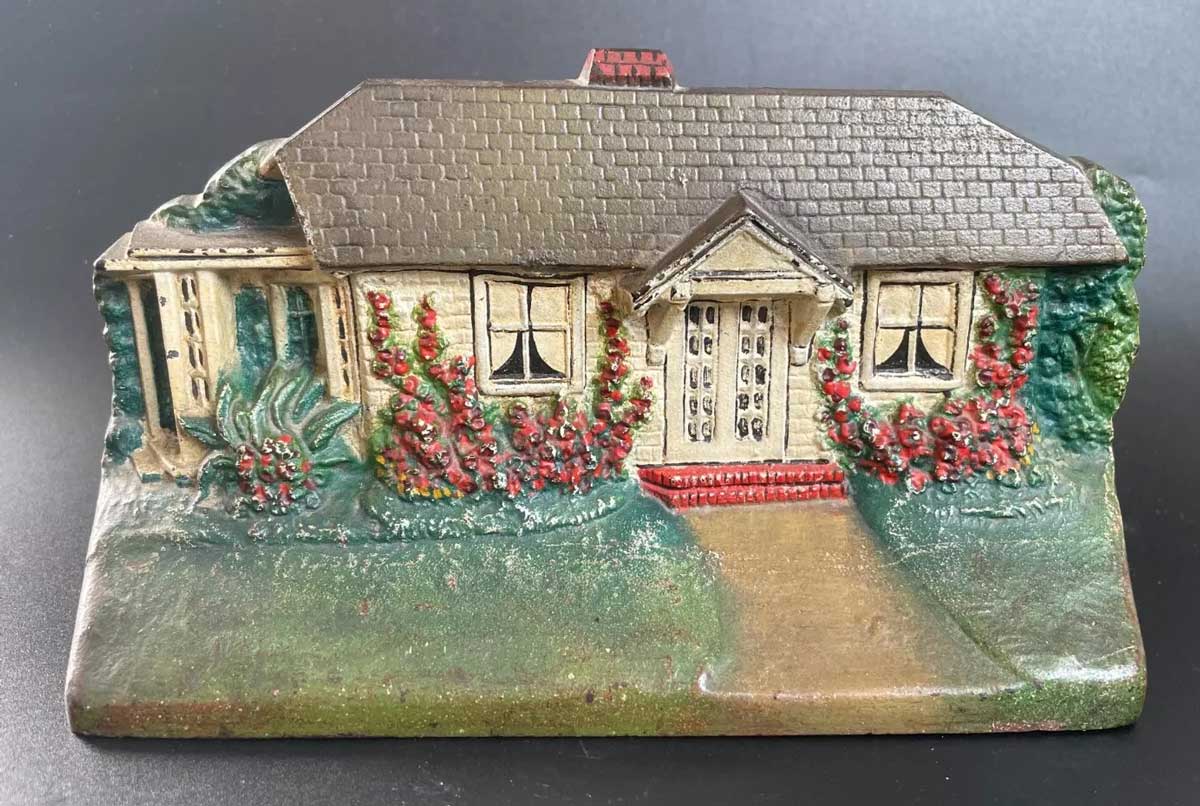
This Judd Co. cottage doorstep sold on eBay on Feb. 2, 2025, for $135. The seller dated it to the 1930s. While I wouldn’t trust most eBay listings without verification, this one had photos that included the underbase, marked with the distinctive JCO hallmark for this company and the number 1283 (Numbers used by this company were four digits from 1242 to 296). It sold for $385. Another cottage doorstop allegedly of the birthplace of Sophia Smith, founder of Smith College, unmarked but featured in John and Nancy Smith’s book on page 135, sold on eBay three days later for $716. (Image courtesy of eBay)


The value of old doorstops can range from much less than $100 to several hundred dollars. As with any antique, value hinges on the factors of condition, desirability, and rarity. The doorstops have a collector club, Figural Cast Iron Club. You can also find out more information about collectible doorstops in “The Doorstop Book: An Encyclopedia of Doorstop Collecting” by John and Nancy Smith. Information on the club, the book, and samples of antique doorstops can be seen on the website, American Sampler (castirononline.com and castirononline.com/doorstop_collecting_book).

Extreme wear and paint loss will affect value, but few genuine antique examples won’t have some paint loss or other signs of wear. While extreme pitting or rust will negatively impact the value, antique doorstops should never be repainted. Painting in mint condition is very rare in a genuine antique.

Peggy Whiteneck is a writer, collector, and dealer living in East Randolph, VT. If you would like to suggest a subject that she can address in her column, email her at  allwritealready2000@gmail.com.
Some ‘almost’ antique kitchen and dinnerware

February 2025

Good Eye

Some ‘almost’ antique kitchen and dinnerware

by Peggy Whiteneck

When I began collecting mid-century American-made kitchen and dinnerware sets, I quickly learned that even items made by entirely different manufacturers could be pleasingly matched on the same table. Fast-selling dinnerware sets were imitated by competing companies. My first discovery of this phenomenon was in Brown Drip pottery dinnerware, made by Hull (from the 1960s to ‘80s) and McCoy potteries (from 1968), both no longer in production. These are so closely aligned in color and foam treatment that they are virtually indistinguishable from one other without flipping the items over to check the mark. What this allows one to do is mix and match the items so as to make complete sets despite their not all being in the same brand (Such is not the case with Pfaltzgraff brown foam from the 1940s, where the brown in the body is so dark as to be nearly black that tends to clash with the lighter brown of the other two brands. As with the other two companies, though, Pfaltzgraff is no longer in production).

Then I found a hen on nest casserole dish that looked very much like my brown foam sets. It turned out to be made of glass rather than pottery, but its mix of brown and tan colors displays quite nicely among my Hull and McCoy. The hen on nest has a Westmoreland mark.

Fiesta is a pottery dinner and kitchenware brand known for its colorful mix and match sets, whose earliest colors, beginning in 1936 and into the 1950s, have become very collectible: red, yellow, cobalt blue, green, and ivory and (added in 1937) turquoise. With a gap during World War II, the red continued in production through 1972. Other colors, e.g., rose and gray, are more recent. The earliest Fiesta pieces have an inked backstamp on the bottom that says GENUINE (in caps) and fiesta (in lower case). The Homer Laughlin Co. dates from 1877 and is still in business.

My parents were early collectors of Depression Glass, and when my mom was trying to clear out some collectibles (to make room for others!), she gave some Depression dinner sets to my three sisters and me. Luckily, we were each attracted to different sets! I had always loved the American Sweetheart Monax dinnerware, of which my mom had nearly a complete set. Monax is a white color that thins to an almost transparent opalescence around the edges. Mom also gave me her set of Monax Petalware made by MacBeth-Evans in the 1930s (making it nearly antique!), which features a similar opalescence and matches nicely to fill in empty spots in my American Sweetheart set - which was, incidentally, made by the same company in the same era. I have long been struck by the fact that Depression glass, cheaply made at manufacture, has lasted so well for nearly a hundred years!

Recently, I found in an antique shop a set of four stemmed tumblers in Fenton’s French Opalescent hobnail, which matches very nicely with my Monax dishes. This Fenton tableware was made between 1940 and the early 1950s. I confess I’ve never personally seen the dinner and other plates in this treatment, but they are listed in books such as Margaret and Kenn Whitmyer’s Fenton Art Glass Patterns, 1939-1980.


Coudersport Duck on Nest

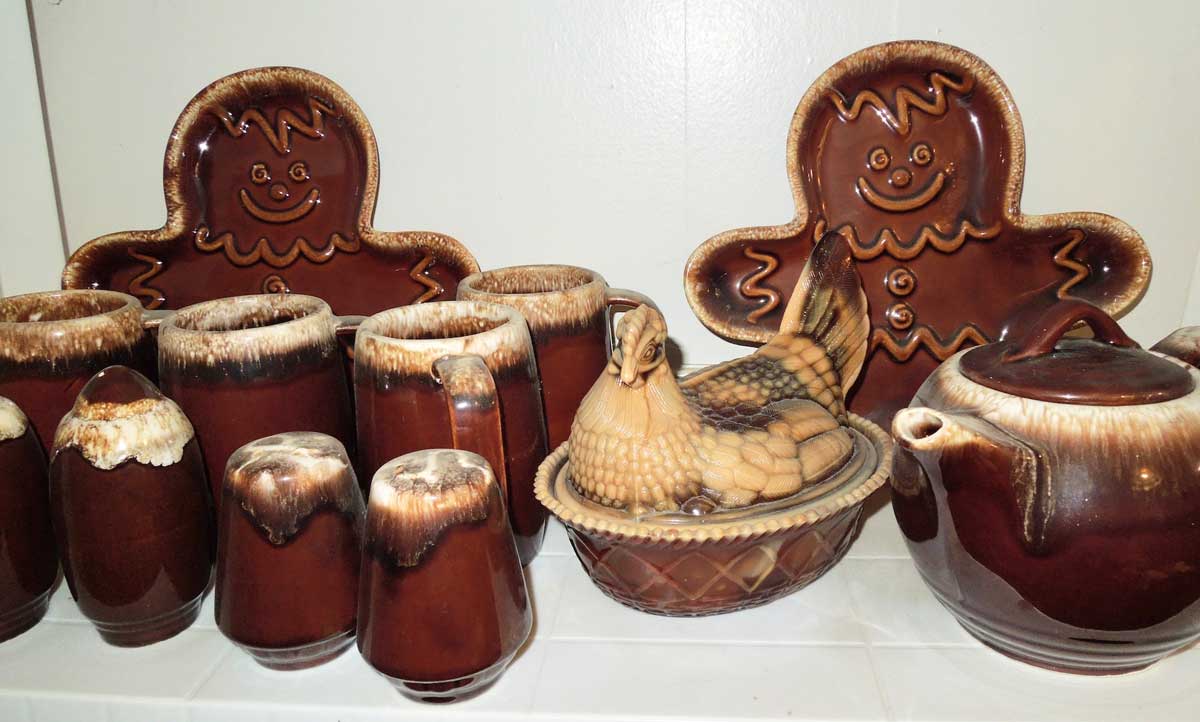
This photo has just a sample of the approximately 200 pieces of Brown Drip pottery in my collection. The two rare gingerbread trays were made by Hull, as were the mugs at left. The salt shakers are probably Hull (bottoms too small for a mark). The teapot at right is McCoy. The hen on nest is Westmoreland Glass that matches nicely with the pottery. Note: the bottom rims of these American pottery pieces are the off-white of the original clay used to make them. Brown Drip was also imitated by Japanese companies, but the unglazed bottom rims on those will be brick red. (Image courtesy of the author)arketed under a Christmas name (here, “Christmas Star Series”) featured decoration that was more generically winter-themed. (Image courtesy of the author)


Amateur collectors often confuse Moonstone, made by Anchor Hocking beginning in 1942, with Fenton’s French Opalescent hobnail pieces. The hobnails on Moonstone are rounded at tips whereas Fenton’s are pointed, and the shapes of the pieces are often distinct from each other as well. Some pieces with basic forms, such as creamer and sugar, may complete a table set with Fenton. Moonstone was also made in other colors: pink, ruby, and clear with a red trim.

Some of the basic pieces from these various dinnerware sets can still be found in antique shops, but nearly all items are becoming increasingly scarce.

So grab ‘em while you still can!

Peggy Whiteneck is a writer, collector, and dealer living in East Randolph, VT. If you would like to suggest a subject that she can address in her column, email her at  allwritealready2000@gmail.com.

Little lights for winter celebrations

December 2024

Good Eye

Little lights for winter celebrations

by Peggy Whiteneck

Candlelit fairy lights (AKA fairy lamps) were popular in the 19th century before access to gas and electrical lighting. George Miller Clarke invented fairy lights in England in 1844, just about the dawn of the Victorian era. These lights consisted of a base, into which a candle could be inserted, and a chimney or shade. They would provide light when placed at intervals in hallways or rooms.

Their appearance differed from kerosene lamps in that fairy lamps were more colorful and decorative but also smaller; typical kerosene lanterns were strictly functional, consisting primarily of a tall shade and oil reservoir made of clear glass.

After Clarke introduced the form, several other Victorian companies produced fairy lights, being careful not to infringe on Clarke’s designs. These included Pairpoint, Baccarat, Hobbs Brockunier, Central Glass, and Daum, among others (www.fairylampclub.com). Later producers included Indiana Glass, Westmoreland, and Fenton.

Even though it didn’t start making them until the 1950s, fairy lights made by Fenton Art Glass Co. have become popular with modern collectors. The company issued fairy lights to celebrate seasons from winter to spring and holidays from Easter to Halloween to Christmas to … well, you name it. Fenton was especially interested in celebrating Christmas as a Christian holiday, but it was also careful to make the decoration of most of its winter-themed lights generic so that they can be enjoyed by those of other faiths (or no faith affiliation at all). Let’s not forget, for example, that December also brings us Hannukah, the Jewish “festival of lights.”

This article focuses on fairy lights, of whatever maker, that were made to celebrate winter and its holidays, a time when these twinkling lights are especially welcome in the dark nights – and often sunless days - of the season. But first, some information about safe usage.

Safety First

The oldest fairy lights generally consisted of one solid piece of glass with a tall stem and a wide skirt. (It’s worth noting here that the first ones Fenton made had a candle access hole that was too narrow to accommodate a votive candle, the size of choice for fairy lights. The company subsequently widened their one-piece lamps just enough to accommodate a votive.) Other fairy lights come in several shapes and numbers of separate parts. Most consist of the base with a separately molded top (two-piece), others of the base, globe, and a separate candle base between them (three piece).

Glassmakers, including but not limited to Fenton, that made fairy lights for distributor LG Wright even made four-piece forms, in which the fourth piece was a clear glass cylinder to hold the candle that was inserted into the middle, recessed holder found in the three-piece models. Consequently, these lamps look like three-piece models when viewed from the outside.

The insert that was this fourth piece may have been Wright’s effort to protect the outer globe from flame damage, it having been discovered that votive lights can generate sufficient internal heat to crack the chimney part of the lamp. Consequently, today’s collectors of all fairy light forms prefer to use shorter tea lights that generate far less heat - or, better still, LED-battery votives that generate no heat at all.


Coudersport Duck on Nest

While the Fenton Co. did make at least two series of winter fairy lights that featured Nativity scenes, most Fenton two-piece fairy lights issued for winter, even when marketed under a Christmas name (here, “Christmas Star Series”) featured decoration that was more generically winter-themed. (Image courtesy of the author)


Winter Holiday Lights

Although Fenton created fairy lights to celebrate Christmas, its seasonal designs were not limited to Christmas themes. Many of these were more generically winter-themed, as in the group shown here, thereby avoiding religious exclusivity in market targeting.
Several fairy light makers mentioned above did produce undecorated glass colors, including green, red, and amber, that can be apt for the winter holidays, while these other makers usually did not feature painted globes. Westmoreland was the notable exception with its many decorated motifs, including a lushly decorated two-piece holiday light in the shape of an electric table lamp (a form also made at Fenton) with a poinsettia theme.

It’s December in the dark season … so let there be light!

Peggy Whiteneck is a writer, collector, and dealer living in East Randolph, VT. If you would like to suggest a subject that she can address in her column, email her at  allwritealready2000@gmail.com.

Gobble up these collectibles for Thanksgiving

November 2024

Good Eye

Gobble up these collectibles for Thanksgiving

by Peggy Whiteneck

Pilgrim forms made of cloth, straw, or ceramics are useful as decorations for Thanksgiving but not so much for the rest of the year. Broadening our focus, there are many Thanksgiving-appropriate collectible items, including some that can be used year-round and not just for that particular holiday.

When I think of Thanksgiving, my first thoughts don’t go to the pilgrims but to the Native Americans who welcomed them. There are many Native American arts, antique and newer, that are especially apt for Thanksgiving and beyond. Think, for instance, of indigenous baskets that can be used to display direct-from-the-garden squash, potatoes, carrots, and gourds. Since many families break out the simple, non-figural nutcracker for this holiday, smaller examples of native basketry can be used to display the nuts in shells (And among the more decorative - but not necessarily edible - nuts for the season, we also have the humble acorn!).

Old Thanksgiving postcards and greeting cards can also be used to decorate a table centerpiece or the walls of the dining room in celebration of the November holiday.

Turkeys are ubiquitous at this time of year – and not just the ones with feathers! Serving pieces and planters in turkey form have been made of pottery and other ceramics, metal, and glass. Glass covered turkeys can be found in which the top lifts away; these have been made by LE Smith and Mosser Glass. Turkey displays have been made of every conceivable raw material, from pine cones to cloth to yarn. You can even find “stuffed” turkey doorstops.

Pumpkins are a popular Thanksgiving collectible, real ones right from the garden or decorative examples, old and new, made of glass, stuffed cloth, or other material. Non-edible ears of corn made of ceramics and three-ear gatherings of natural Indian corn (with multi-colored kernels), usually made for display rather than eating, make great door decorations.

I’m especially fond of decor-ating with gourds, non-edible as they may be, because they grow in so many colorful shapes and forms. And they last a long time as well, so you can get them at harvest at the end of summer and still have them for decorating at Thanksgiving and for weeks afterward.
Small bundles of natural wheat can also be used as harvest décor, but wheat shocks have also been rendered in non-edible forms. Among these are the wheat vases first made in Czechoslovakia and later popularized by Fenton Art Glass, in which the vase flares at the top and is surrounded by glass roping and lobes sculpted on the body of the vase to simulate the shocks of wheat.


Coudersport Duck on Nest

This #9370 large, brown glazed turkey platter was made by McCoy in the 1970s. Marked ovenproof. (Image courtesy of the author)


In the mid-1950s, Homer Laughlin and other companies also made gold-accented wheat dinnerware (often called “MCM,” for mid-century modern) that would look fabulous on a Thanksgiving table. The 1960s brought us yellow wheat sheaves on white Fire King table and kitchen glass. In the 1970s, Libbey made “Golden Wheat Sheaves” plus other wheat sheaf design tumblers. Much of this mid-century glass and ceramic tableware can still be found in antique and consignment shops.

A hugely popular collectible has been the Corn King and Corn Queen pottery sets of mugs and other tableware first developed by Shawnee Pottery in the 1940s and acquired by Terrace Ceramics in the 1960s, which made it in a brown drip form for just a few years more.
Another good idea for Thanksgiving table display is the cornucopia, a symbol of abundance also known as the horn of plenty, a horn-shaped lateral basket open at one end that can be used to display small fruits, vegetables, or fall flowers.

Placemats with Thanksgiving themes are eye-popping table droppers – just be sure they don’t overpower your other table décor for the holiday.
Thanksgiving has been a popular home decorating theme for at least a century – so the ways for developing it at our own homes are endless -- for which we can all give thanks!


Peggy Whiteneck is a writer, collector, and dealer living in East Randolph, VT. If you would like to suggest a subject that she can address in her column, email her at  allwritealready2000@gmail.com.