
America’s greatest hits – quilting edition – Part II
May 2025
Covering Quilts
America’s greatest hits – quilting edition – Part II
by Sandra Starley
Creating a presentation on 250 years of American Quilting and Quintessentially American Quilts for the American Quilt Study Group was a fantastic opportunity to study our amazing quilt heritage. Again, I would love to share pictures of all the epic quilts that I reviewed, but instead I will give you an overview. I hope you will be inspired to follow up and start searching using the keywords I share below. Americans did not create quilting, but we have definitely made it our own!
The Flowering of American Quilts 1840-1870:
Time of Growth, Industrialism, and Westward Expansion
This is the period when American Quilting really developed its personal identity. Mid-century quilters expanded upon the signature album or friendship quilt phenomena that began in 1840. It blossomed with the detailed Baltimore Albums, one of the icons of quilting. Chintz applique was transformed from medallions into blocks used in signature quilts. And speaking of blocks, the block format especially pieced blocks of stars with alternating plain blocks began to develop as a uniquely American style. Elaborate red and green appliqué are classic patterns of this era. Red and green were popular home décor colors that translated to quilts, both appliqued and pieced. This was also the start of published patterns and more fabric being produced in America. Most importantly, the time-saving marvel of the sewing machine was becoming available to the public.
The Grand Epoch 1870-1900:
Centennial Celebration for a Grown-up Nation
It is difficult to really convey the extant of the enthusiasm and significance of the Centennial Celebration to this seasoned nation. Those of us who remember the Bicentennial know a bit about Centennial fever, but the quilters of 1876 really took the commemoration up to the nth degree. There was a frenzy of piecing and competition to see how many different pieces could be utilized in a single quilt. Fabric was so accessible that makers could easily make quilts with 1,000 or even a celebratory 1,876 separate fabrics. Patriotic fabric with symbols of the American Revolution and dates of 1776 and 1876 were extremely popular. If you find a circa 1880 charm or scrappy quilt, be sure to look closely for a Centennial fabric! Piecing was king during the period, mostly due to the availability of sewing machines.
Crazy for quilting
This period also gave birth to the most widespread quilting craze of all time: the Crazy Quilt. These wonderful works of velvet, silk, and satin covered with elaborate embroidery began in the early 1880s, and after just a few years, ladies’ magazines were complaining about the obsession they had created. In 1890, Good Housekeeping said:
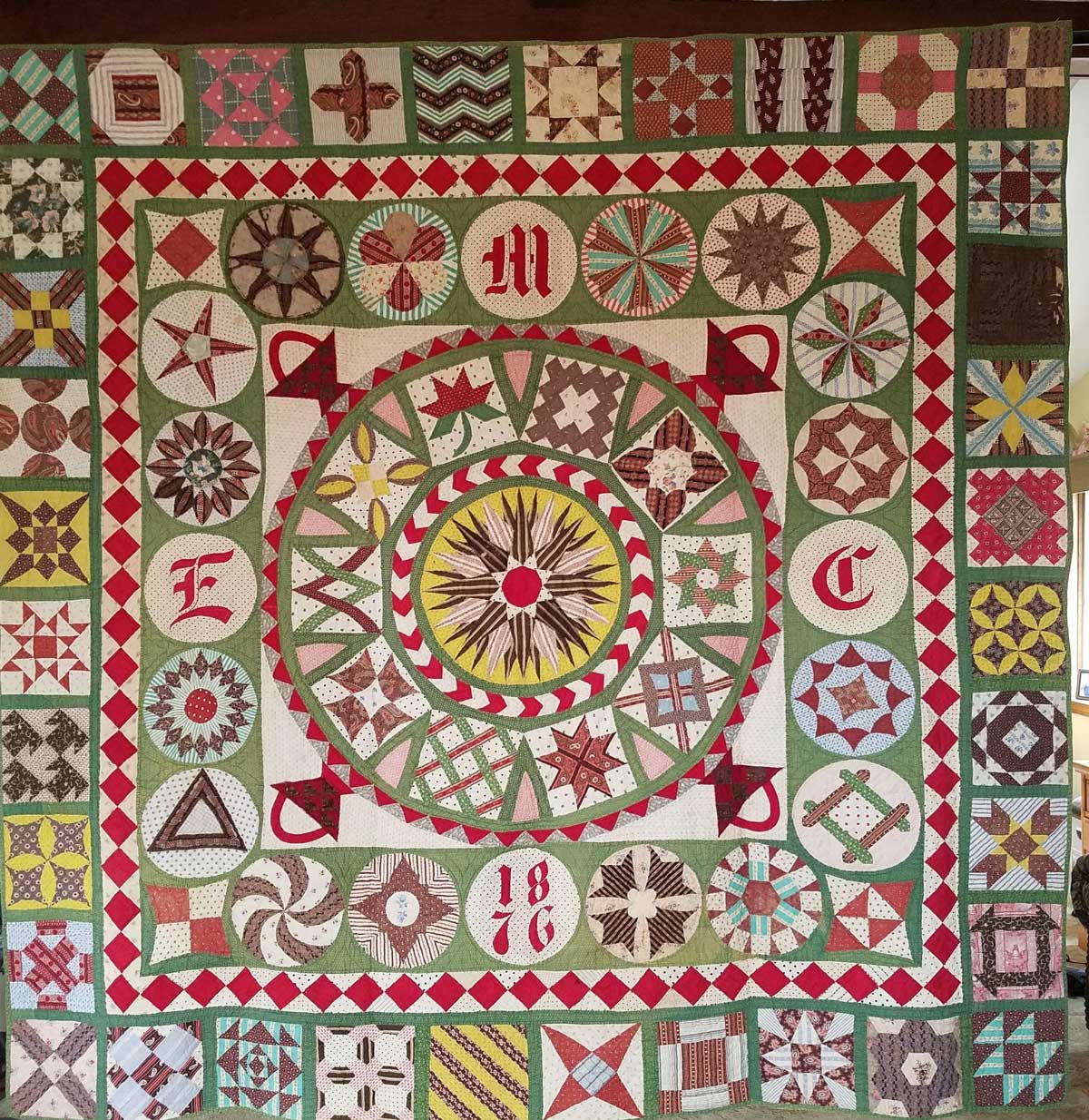
An 1876 Sampler Block Medallion from the collection of Barbara Menasian. (Image courtesy of Barbara Menasian)
“But make it she must,
She will do it or bust,
Beg, swap, and buy pieces or get them on trust,
Oh, the Crazy-quilt mania, may it soon cease to rave
In the land of the free and the home of the brave.”
Clearly, the rise of fabric production in America combined with increased industrialization resulted in more access to fabrics and tools and leisure time to indulge in creative sewing. Patterns were being widely published and sewing machines were common. All of this led to a democratization of sewing. Quilting was finally a pastime available to the masses, not just reserved for upper middle class to the wealthy.
Tune in next month to learn about all the exciting developments in American quilting from 1900 onward, including the rise of quilt designers and the business of quilting. More celebrations ensued, including Washington’s 200th birthday, the Bicentennial, and the Millenium and Y2K quilts.
Sandra Starley is nationally certified quilt appraiser, quilt historian, and avid antique quilt collector. She travels throughout the U.S. presenting talks on antique quilt history, fabric dating classes and trunk shows as well as quilting classes. Learn more at utahquiltappraiser.blogspot.com. Send your comments and quilt questions to SandraStarley@outlook.com
French Star or American Star revisited
September 2023 Covering Quilts French Star or American Star revisited by Sandra Starley One of my all-time favorite antique quilt patterns is the French Star. I love sharing information about the block and hope to uncover more antique quilts featuring this design. I…
Still crazy after all these years! Crazy Quilts – Part II
August 2023 Covering Quilts Still crazy after all these years! Crazy Quilts – Part II by Sandra Starley Crazy Quilts have been an iconic part of quilt history since the 1800s. Similarly, Discover Vintage America has been a sustained force in antiques and history…
Crazy quilts showcase beauty in irregularity
July 2023 Covering Quilts Crazy quilts showcase beauty in irregularity by Sandra Starley What do a Victorian parlor, a Wizard of Oz char-acter, and a Batman villain have in common? Crazy Quilts! From ladies’ magazines in the 1880s to The Patchwork Girl of Oz in…
Classic patterns made modern – Rocky Road to Kansas
June 2023 Covering Quilts Classic patterns made modern – Rocky Road to Kansas by Sandra Starley Last month, I wrote about the origins of the classic antique quilt pattern, Rocky Road To Kansas. While it sounds like a design dating back to the pioneer days of…
Classic Patterns: Rocky Road to Kansas
May 2023 Covering Quilts Classic Patterns: Rocky Road to Kansas by Sandra Starley Quilt names : ‘Rocky Road to Kansas,’ ‘Texas Tears,’ and ‘Rocky Road to California’, It’s a quilt name that stirs up images of wagons full of bonneted prairie ladies busily…
Puff Quilts are back – Part 2
April 2023 Covering Quilts Puff Quilts are back – Part Two by Sandra Starley Those puffy, pillowy quilts from the 1970s are back and better than ever. Puff, pillow, biscuit, or bubble quilts are generally extra puffy or dimensional. There are myriad methods…