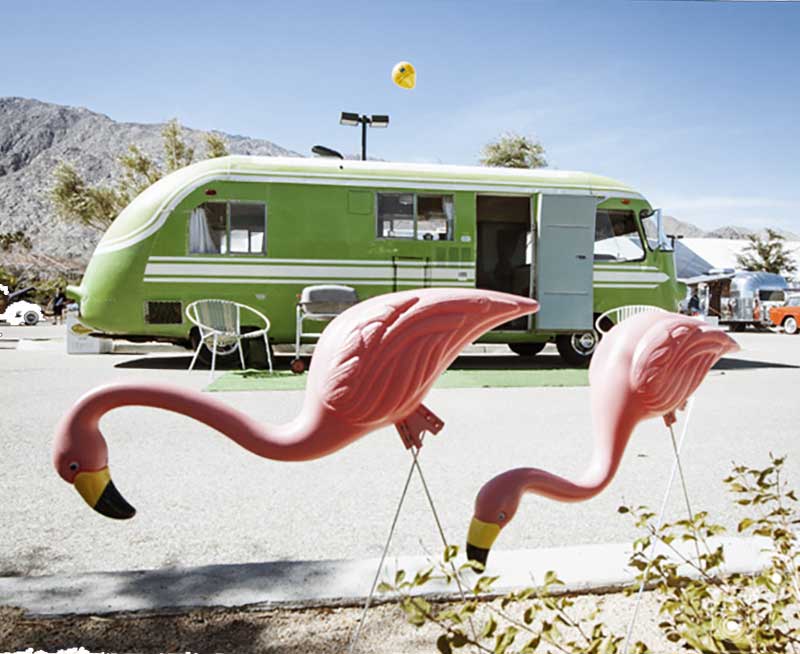
Let’s go to the movies Vintage movie venues have entertained audiences for decades

Let’s go to the movies Vintage movie venues have entertained audiences for decades

(Photo by Patti Klinge)

September 2022

Cover Story

Let’s go to the movies

Vintage movie venues have entertained audiences for decades

by Corbin Crable

Streaming services, be advised – you can’t keep a good movie theater down.

People have predicted the death knell of movie theaters for years, but they continue to be a draw for those who love a good, old-fashioned moviegoing experience. Those experiences you remember vividly from your youth remain available at small, independently-owned venues throughout Kansas, Missouri, and the rest of the country. They have a long history, whose richness matches the loyalty of the customers who visit them regularly. In this issue of Discover Vintage America, we take a peek behind the curtain of just a few.

The Glenwood Arts and The Rio Theatre – Overland Park, KS

This year, twin brothers Ben and Brian Mossman celebrate 40 years in business as the Fine Arts Group, which has owned and operated independent movie theaters in the Kansas City metro area since 1982.

The Mossman brothers’ current theaters – both located in Overland Park – are The Glenwood Arts and The Rio. Like most businesses, the theaters closed in the early days of the COVID-19 pandemic; the five-screen Glenwood Arts has since reopened, and the single-screen Rio remains temporarily closed.

Over the years, the Fine Arts Group’s theaters have come and gone, though they’re still spoken of lovingly by former customers – The Fine Arts Theatre, The Englewood, and Red Bridge, just to name a few.
Glenwood Lobby

Lobby of the new Glenwood Theatre

The lobby of the new Glenwood Theatre features neon signage for a retro feel. (Photo by Patti Klinge)

Glenwood Arts and The Rio

Both the Glenwood Arts and The Rio offer guests a moviegoing experience that simply can’t be found with large chains like AMC or Cinemark. Before the Glenwood Arts Theatre moved to its current location in the Ranchmart Shopping Center and merged with the shuttered Leawood Theater – which had been owned by Kansas City-based Commonwealth Theaters since the late 1960s before it closed in the 1990s – the Mossmans were able to salvage multiple items, including the original Glenwood’s colorful, atomic-age marquee (which remains in storage). Step into the lobby of the Glenwood Arts and you’ll see original film posters from classic movies like “Duel Au Soleil” (1946) and “Singin’ in the Rain” (1952) among portraits of old-time movie stars like Ava Gardner and James Dean. A neon sign simply reading “Refreshments” buzzes above the concession stand, a large wooden plaque bearing the visages of the twin gryphons of comedy and drama hangs outside auditorium number one (it’s just one of the relics the Mossmans brought over from the Glenwood Arts Theatre in the now-defunct Metcalf South Shopping Center at 95th and Metcalf – that theater operated from 2002-2015, and bore the name of its predecessor, the original Glenwood, which operated from 1966 to 2000). The Glenwood Arts retains the Leawood Theatre’s original seats, and its crest appears splayed across the lobby’s teal-and-purple carpet.
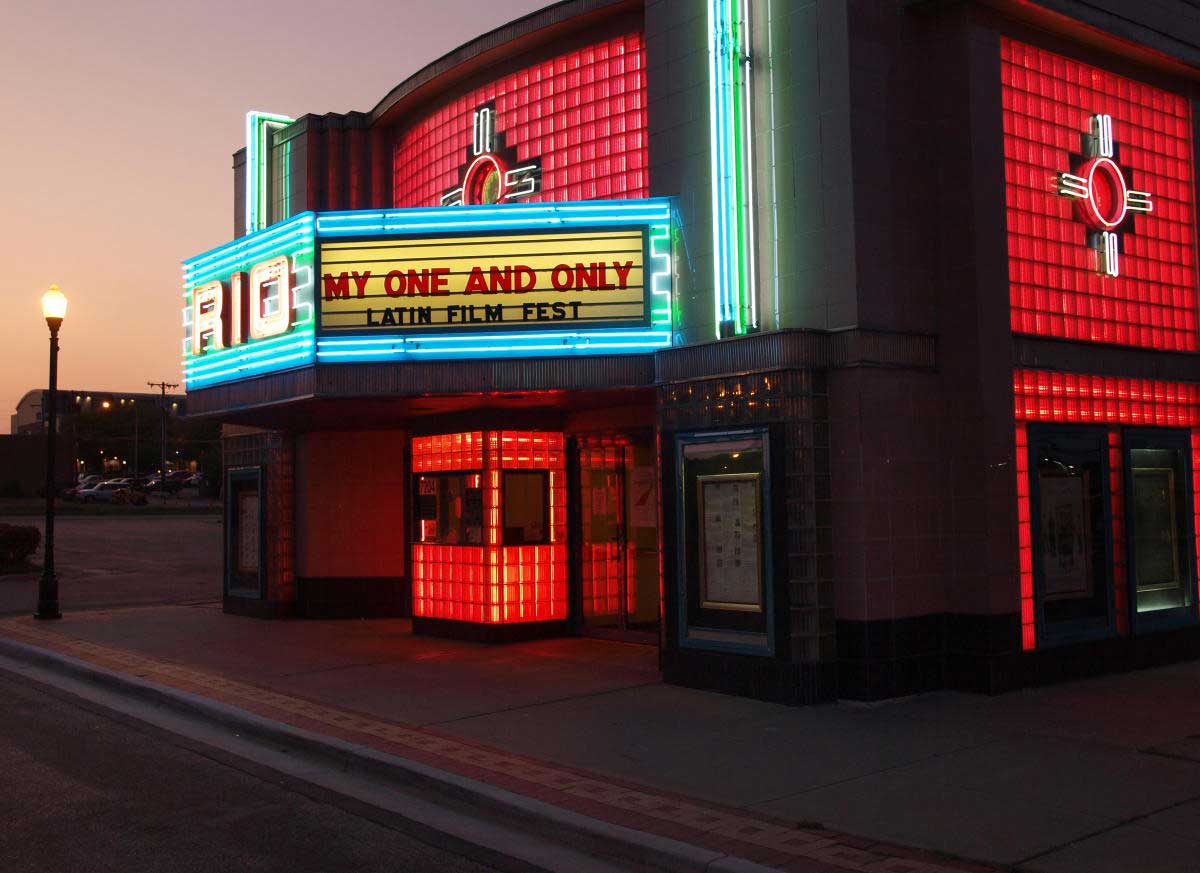
The Rio Theatre in Overland Park, KS

The Rio Theatre in Overland Park, KS

The Rio Theatre in Overland Park, KS, remains closed until more staff can be hired, among other reasons cited by the owners. (Image courtesy of The City of Overland Park)

Our customers are valued

“Our customers are valued. We try to give them information or strike a conversation with them,” says Ben Mossman, president and co-owner of The Fine Arts Group. “We don’t say, ‘Give us your money and go in.’ In one sense, it’s a step back in time. We have artifacts that dictate that. Our theater is neon and glass brick.”

The clientele of both theaters skews older, and though they’re returning to the Glenwood Arts, it’s been a slow climb to get back to attendance numbers that justify adding more showtimes to the theater’s roster.

“Our clientele was more reserved in going out into a group function. They were the first to stay away and the last to come back, mostly due to their age and whether they had health issues,” Mossman notes.

The Overland Theater, which originally opened on Christmas Day in 1946 and would later become The Rio, remains a favorite local landmark of moviegoers. Located near downtown Overland Park, the theater hosted Theatre for Young America in the late 1970s and was sold to the city in 1987. The Mossmans would eventually purchase the building in 1993, and after a years-long renovation process, the thater reopened on June 30, 2000.

“The theater had been brought to life again with all its old style and much of its original material intact,” according to the Johnson County Department of Parks and Recreation. “The revitalized façade features new peach-colored porcelain tiles, neon lighting, aluminum trim, rebuilt poster cases, and a recreated marquee and glass block ticket booth.”

Rumors about the fate of the still-closed Rio have swirled on social media for months, leading followers to speculate whether the theater will remain permanently closed. Mossman says the Rio will reopen once business at the Glenwood Arts is high enough to warrant opening the single-screen location and spending money on its electrical and heating/cooling bills, and upkeep. Another issue is the need for more employees – like so many other small businesses across the country, the Fine Arts Group has had difficulty finding employees in recent months.

“We can’t get help,” Mossman says. “We couldn’t even add showtimes (at the Glenwood Arts), but we don’t have enough help.”
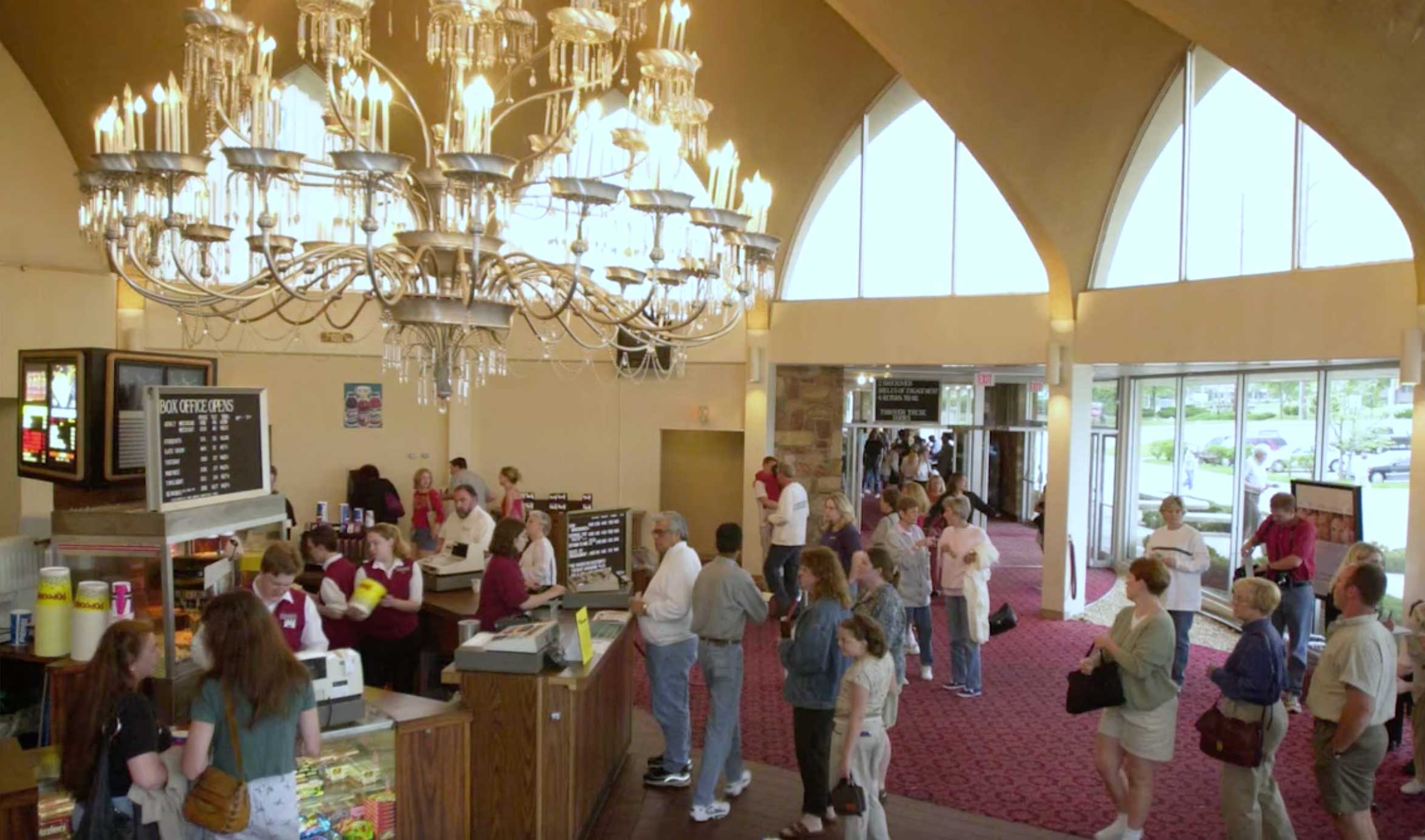
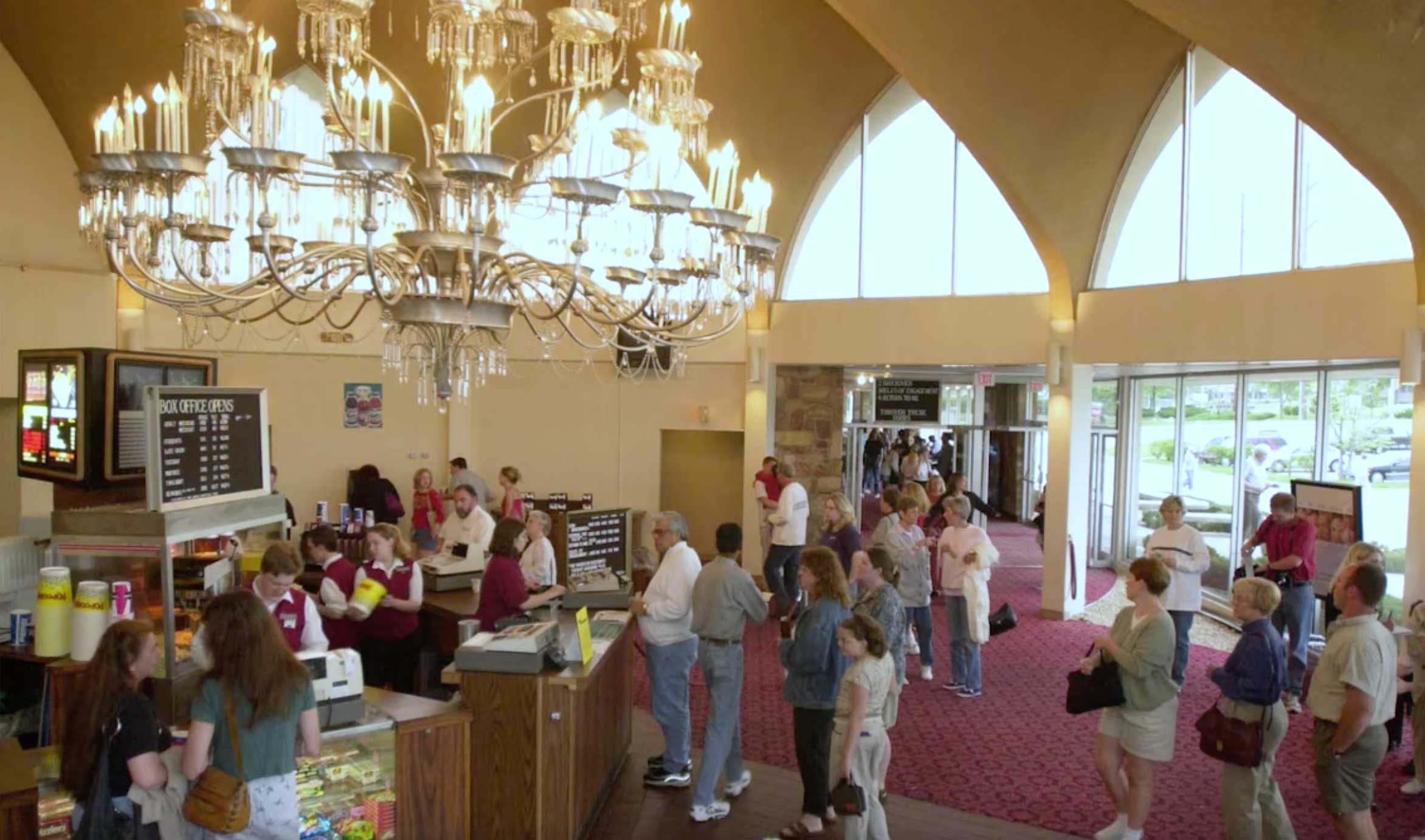
lobby of the original Glenwood

Lobby of the original Glenwood

The lobby of the original Glenwood. The ornate chandelier has since found a new home at the Glenwood Antique Mall in Overland Park, KS. (Image courtesy of Pinterest)
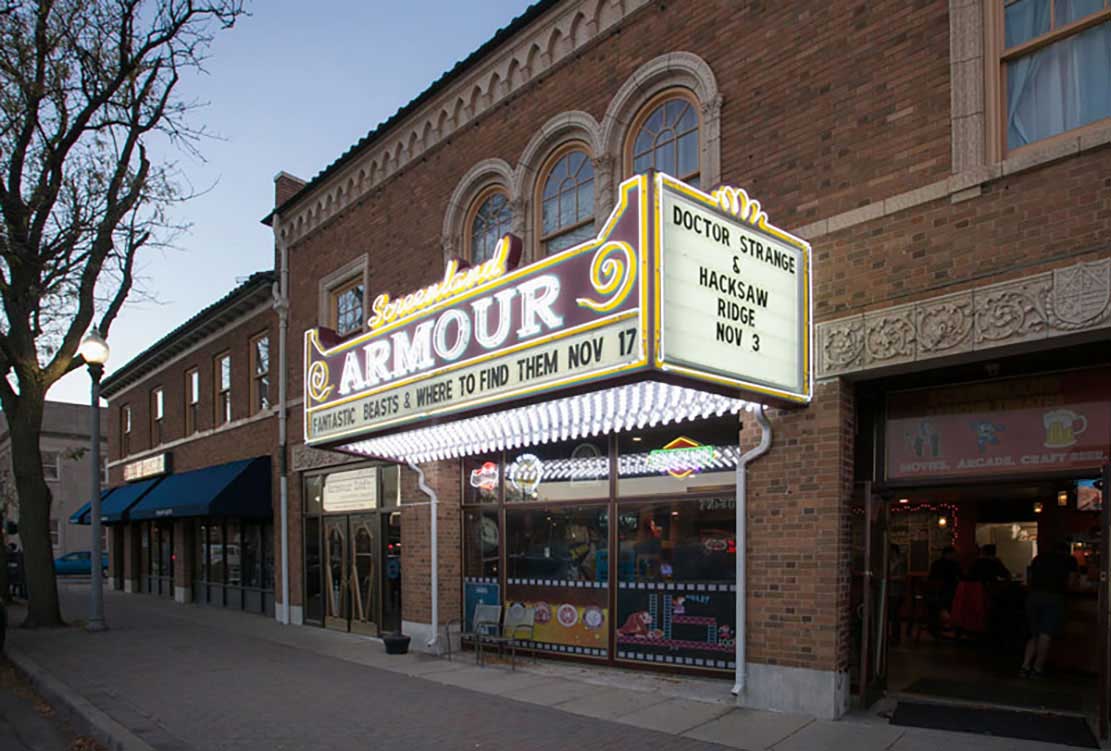
The Screenland Armour

The Screenland Armour

The Screenland Armour’s exterior neon sign illuminates the night sky.
(Image courtesy of Visitkc.com)

The Rio has been listed on the National Register of Historic Places since 2005.

Mossman says he is heartened to see that even as streaming services rise in popularity, audiences still value a traditional moviegoing experience in a vintage or vintage-style theater.

“There is still a great number of people who want the experience of going out to the theater instead of staying home and eating kettle corn,” he says.

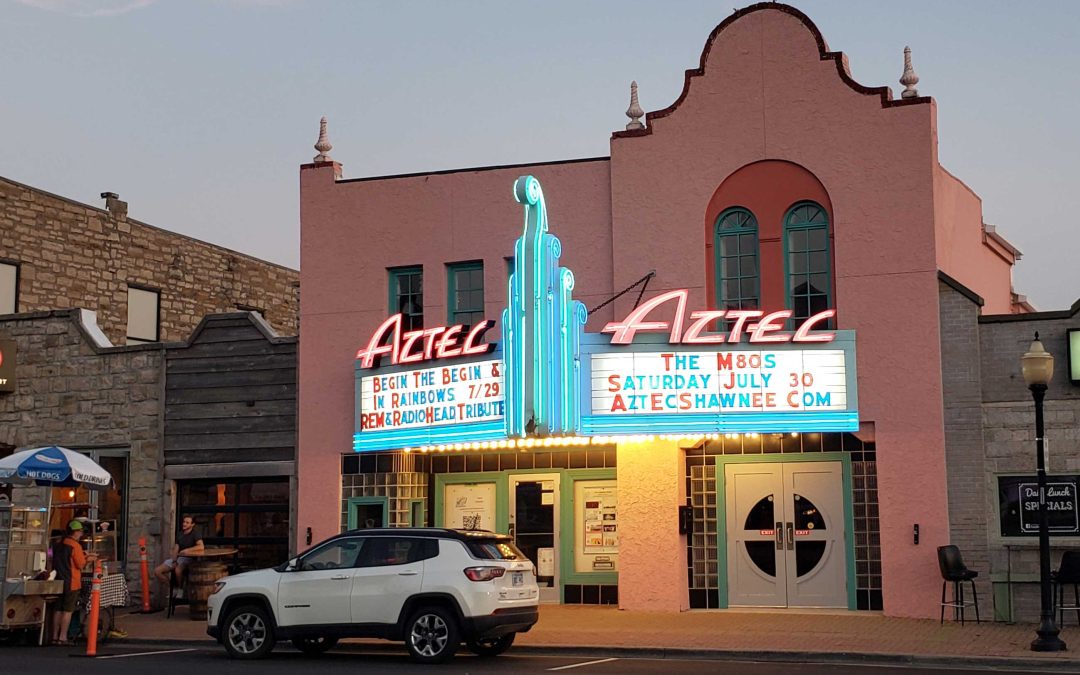
The Aztec Shawnee Theater – Shawnee, KS

Like other theaters in its proximity, The Aztec Shawnee doesn’t only specialize in films – it’s a venue that hosts other events as well.

One of the theater’s owners, Chris Calkins, says he had driven by the shuttered theater “hundreds, if not thousands of times,” in recent years and, in 2017, decided to purchase, renovate and reopen the location with the help of his brother and a mutual friend.

The Aztec Shawnee, which reopened in December 2020, has become a hot spot for a variety of guests and groups, from music lovers to wedding parties to receptions and birthday parties.

“The theater does mostly live bands on Friday and Saturday nights with some weekday and occasional Sunday classic movies,” Calkins says. “Our original goal when we first started planning was for the main focus to be on movies with some live entertainment from time to time but then after doing more research, we figured out that a small venue like ours could never compete with the big megaplexes on movies. to do that.”

Instead, Calkins says, the Aztec Shawnee shows a handful of classic films throughout the year – this summer’s offerings have included “All Quiet on the Western Front” and “The Adventures of Robin Hood.” This fall, classic horror fans won’t want to miss the original “Frankenstein” on Oct. 5 and 12, as well as “Bride of Frankenstein” on Oct. 19 and 28 (The venue’s first movie last year was a screening of the 1931 horror classic “Dracula” with Bela Lugosi). A complete list of all films and live musical performances being hosted by the Aztec Shawnee, meanwhile, can be found at www.aztecshawnee.com.

Besides films, Calkins says the Aztec Shawnee’s frequent collaboration with local businesses is one of the many features that sets it apart from other venues.
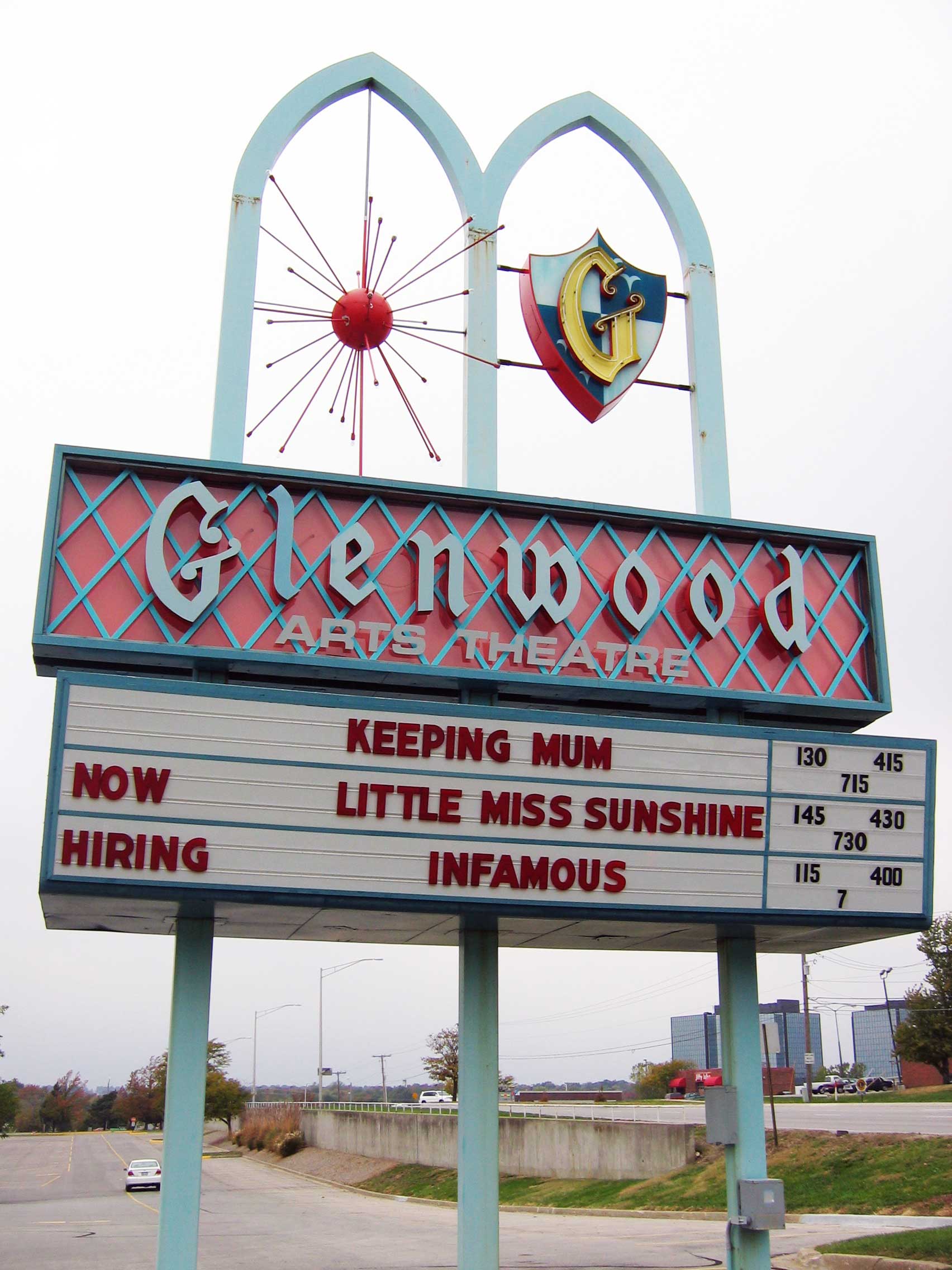
The atomic-age sign of the Glenwood

The atomic-age sign of the Glenwood

The atomic-age sign that stood outside of the original Glenwood Theatre welcomed visitors with a splash of color. (Photo by Patti Klinge)

“On most Friday and Saturday nights, you may find a food truck out front, and we allow the food truck food to be brought into the theater,” he says. “We have also teamed up with McLains Market right around the corner from us on a program where you can order from a specialized menu right from your phone in the theater and they will deliver it to the theater with no delivery charge.”

Calkins adds, “All of these classic movies have been a partnership with Shawnee Town 1929, and if you happen to be a member of The Friends of Shawnee Town, you can call them and get into these movies for free. So far, we have only been charging $5 to see movies at Aztec Shawnee Theater.”

Like other local theaters, the operation of the Aztec Shawnee is a labor of love for Calkins and his family.

“Just the beauty of the inside of the theater keeps people coming back,” Calkins says. “It is definitely a family affair, as at almost any event you will find several family members working the door or the concessions or just mingling with the crowd.”

The Boulevard Drive-In – Kansas City, KS

For a real drive-in experience, the Boulevard Drive-In has been welcoming motorists to its grounds since 1950.

Run and operated by the Neal family, the drive-in remains one of only a handful of drive-in theaters still open across the country. According to the theater’s social media pages, the theater almost closed in the 1970s, but owner Wes Neal was able to save the business by offering weekly swap-n-shop events – and it wasn’t long before sales of antique and vintage goods had saved the theater from closing.

Today, the theater still shows first-run films, the venue instantly recognizable by its sign, which the Neals say they believe should be on the National Register of Historic Places.

For more, including the Boulevard’s seasonal film calendar and swap meet schedule, visit www.boulevarddrivein.com.

And be sure to catch a flick at The Screenland Armour – North Kansas City, MO
The Armour Theater, built in 1928, during the era when “talkies” were the new fad in film, was bought in 2008 by developer Butch Rigby and renovated in 2012 by Adam Roberts and his business partner and brother-in-law Brent Miller. The two renamed the venue The Screenland Armour.

Specializing in independent and classic films – with a few first-run movies thrown in for good measure --  the Screenland Armour celebrated an expansion in 2018, adding two screens, new projectors, sound systems, seats, and even a pizza shop (because what else would you pair with their extensive beer list?).

There are still vintage touches at the Screenland Armour, including its neon exterior signage and vintage arcade games. Be sure, too, to visit the Screenland Tapcade in the Crossroads Art District, featuring a full-service restaurant, arcade games, and regular trivia nights.

Visit www.screenland.com for tickets and showtimes.

Author’s disclosure: Corbin is the social media manager for The Glenwood Arts Theatre in Overland Park, KS.
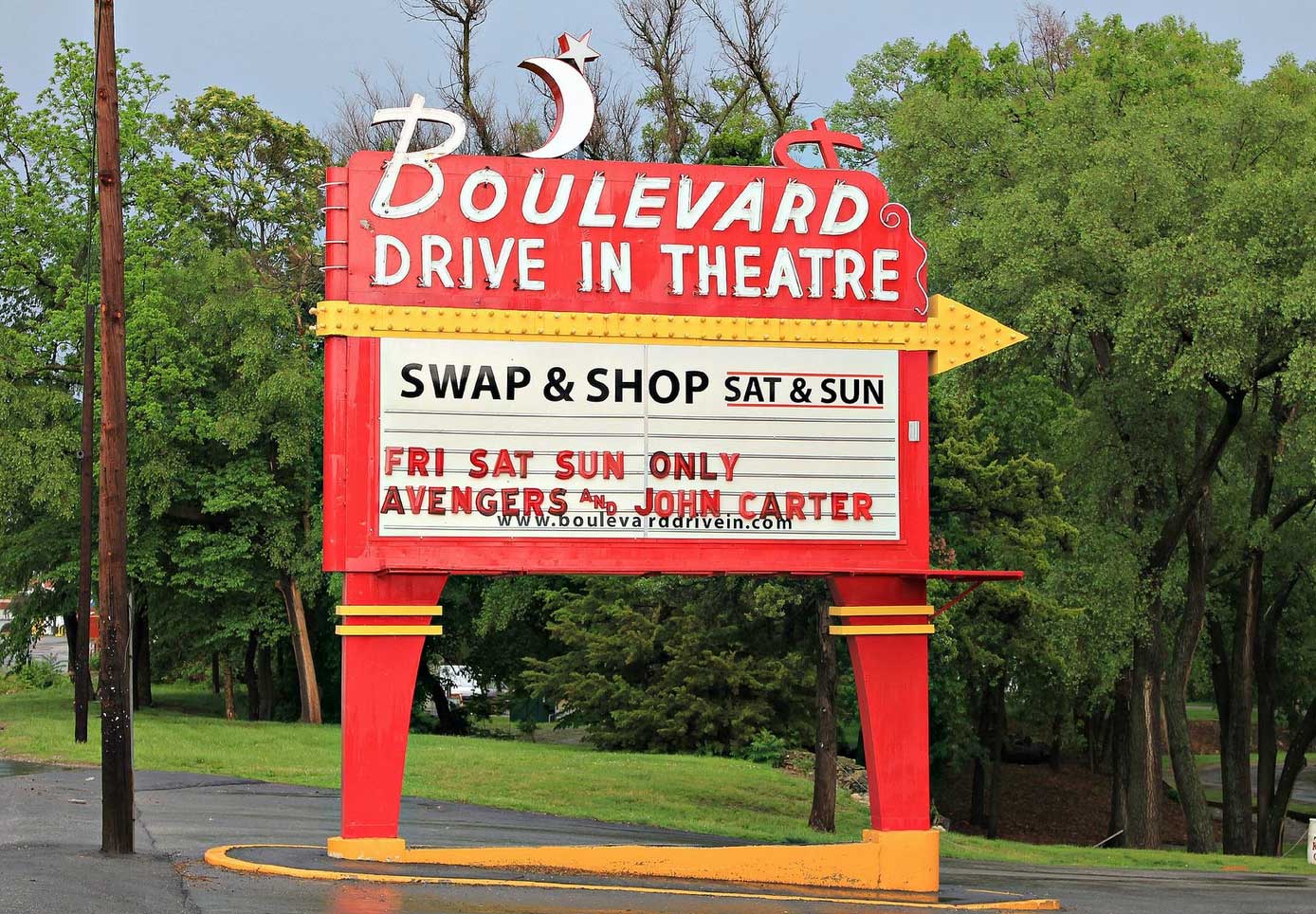
Boulevard Drive-In in Kansas City, KS

Boulevard Drive-In in Kansas City, KS

The sign at the Boulevard Drive-In in Kansas City, KS, advertises the venue’s weekly swap shop. (Image courtesy of Pinterest)
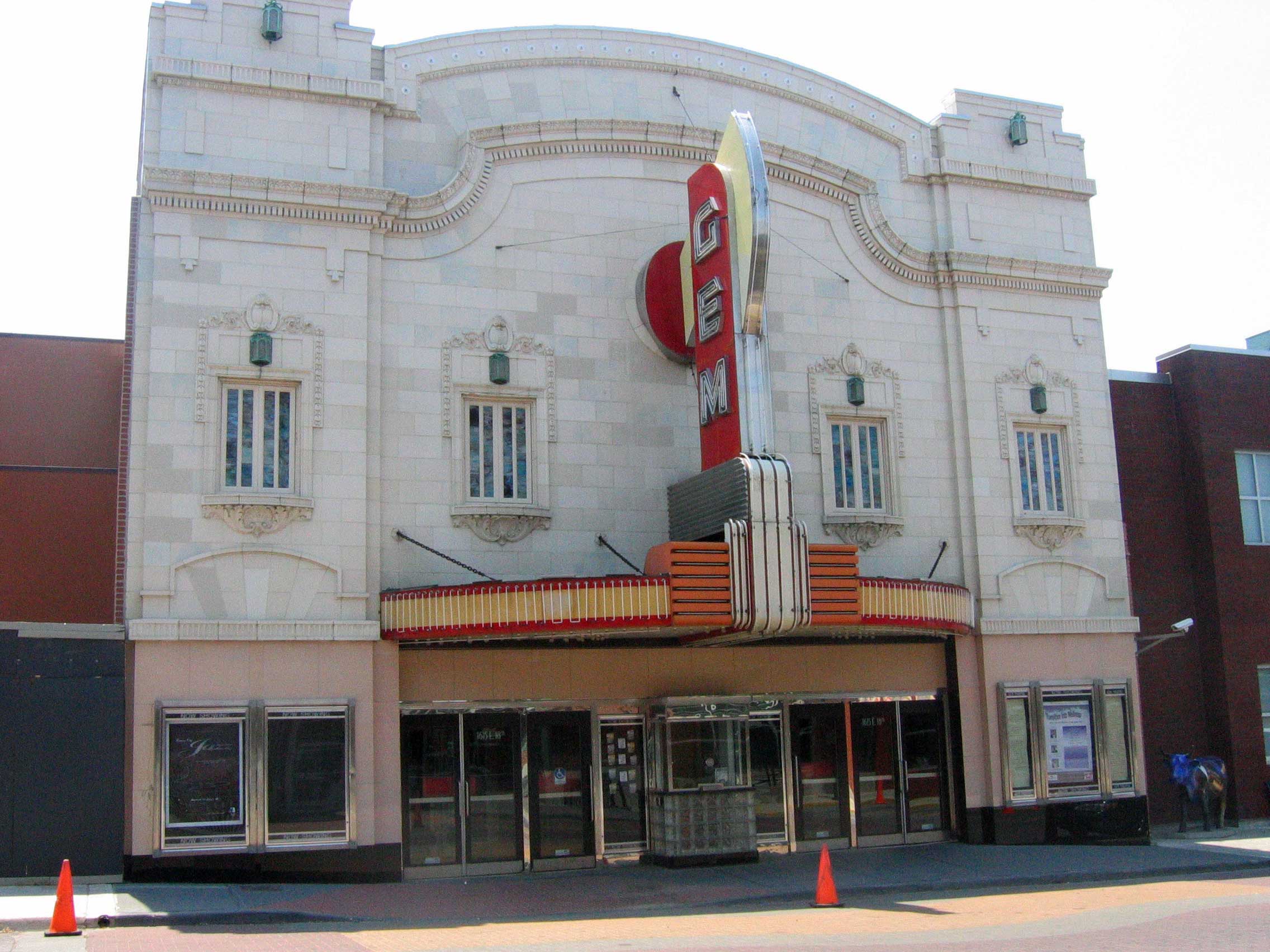
The Gem Theatre in Kansas City, MO

The Gem Theatre in Kansas City, MO

The Gem Theatre in Kansas City, MO, is another example of the beautiful Art Deco style used in the old theatres. Opened in 1912 as the Star Theatre. it was renamed Gem Theatre around 1914 and got a facelift in 1923. The Gem Theatre was built for use by African-American audiences and had a seating capacity for 1,414. Movies continued until the mid-1970s and then went to live performances. Since 1997, after a detailed renovation to create a 500-seat performance space which removed most of the original interior, it has been a venue for the American Jazz Museum located across the street. (Contributed by Chuck Van Bibber; Photo by Patti Klinge)
One-room schoolhouses still educate visitors Schools housed generations of young learners in 19th, early 20th centuries

One-room schoolhouses still educate visitors Schools housed generations of young learners in 19th, early 20th centuries

(Photo by Kyle Bush)

August 2022

Cover Story

One-room schoolhouses still educate visitors

Schools housed generations of young learners in 19th, early 20th centuries

by Corbin Crable

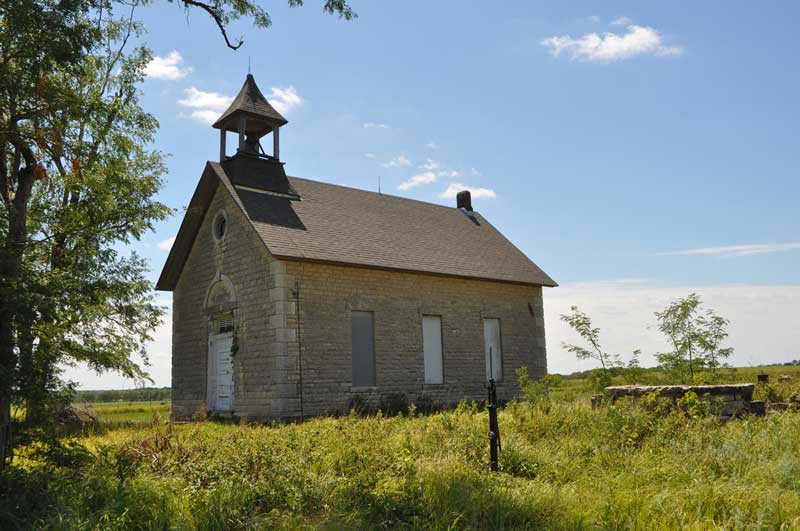
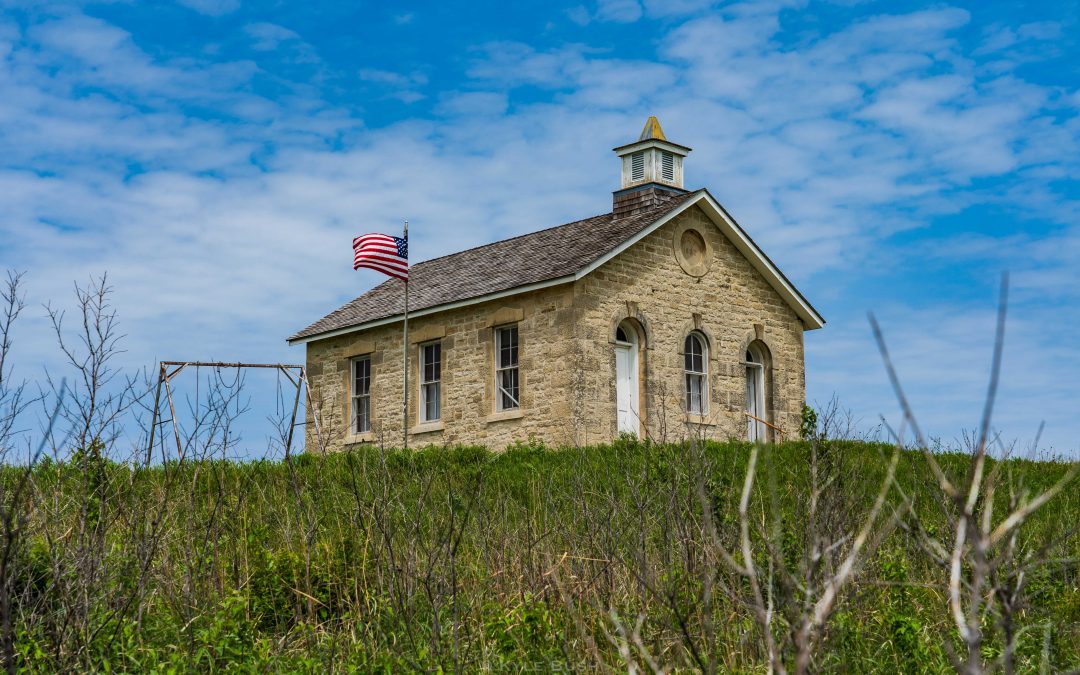
As a new school year begins across the country, it can be easy to forget that one-room schoolhouses, those relics of education from centuries past, remain places of knowledge for students and history enthusiasts alike.

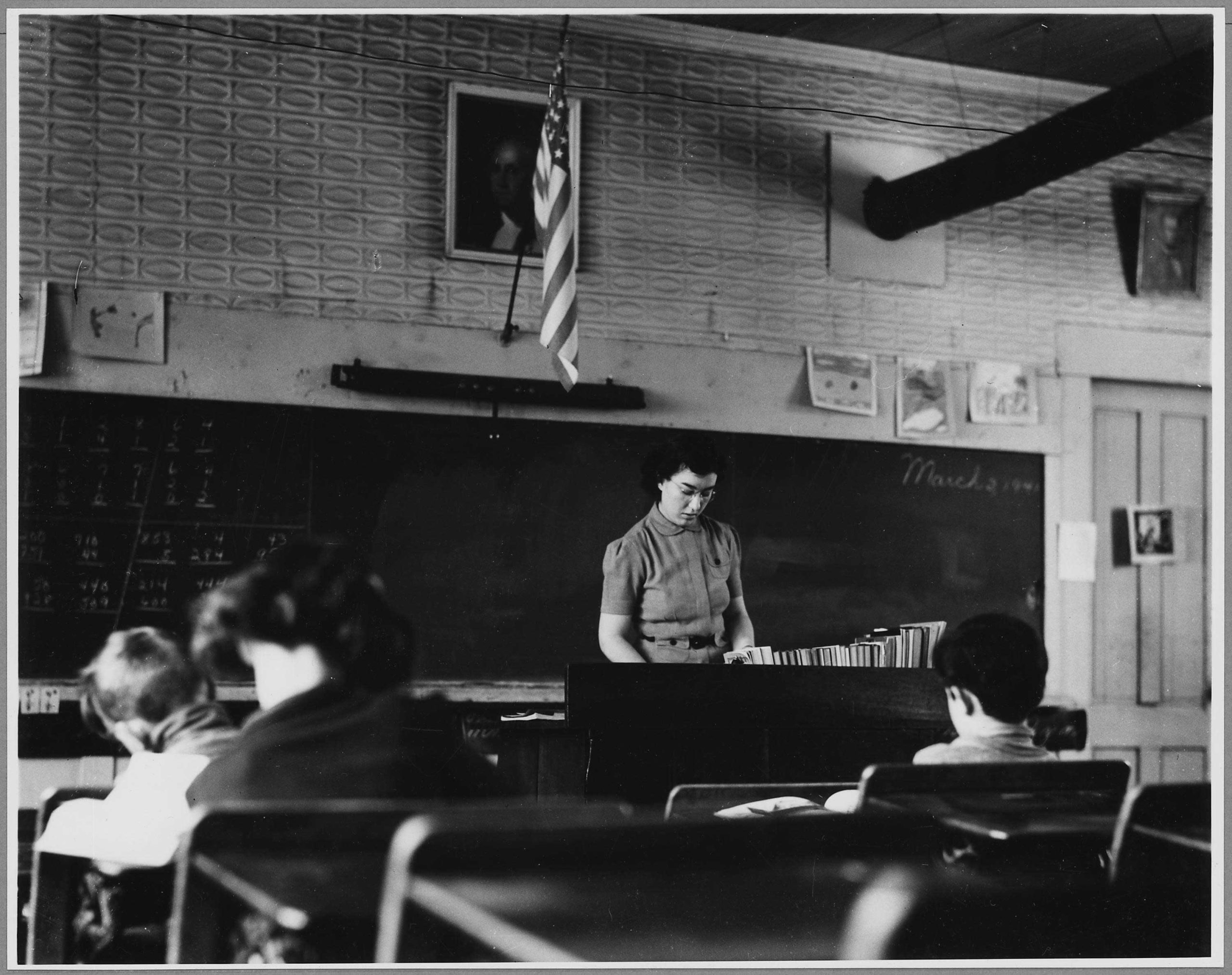
Single-room schools could be found in rural areas both in the United States and abroad – by 1919, according to Forbes.com, around 200,000 dotted rural landscapes in all; these institutions served an important role in molding young minds, especially in 19th- and early 20th-century America. The differences between one-room schoolhouses and the schools of today, of course, are vast. In those one-room schools, students of varying ages – usually grades 1 through 8 -- would learn from one teacher – typically, a young woman; most schools could accommodate as few as six or as many as 40 students, according to the “America’s Story” project from the U.S. Library of Congress.

“The teacher’s desk may have been on a raised platform at the front of the room, and there would have been a wood-burning stove since there was no other source of heat,” according to the America’s Story site. “The bathroom would have been outside in an outhouse.”

One Room SchoolHouse

Teachers in one-room schools

Teachers in one-room schools were usually young women. (Image courtesy of Ancestry)

Tutoring the younger kids

The youngest of the students usually would sit at desks in the front of the classroom, while the oldest sat in the back of the room. Rarely did the older students need to be reminded to help the younger ones, as it was expected of them. And besides, according to the America’s Story site – the older students were all too eager to help their younger counterparts with their studies.

“‘Limited’ by one teacher, the students often helped with the teaching; older kids or those who mastered material more quickly would help others. A student who was advanced in math, for example, could simply do math with the older kids,” writes Brandon Busteed in a 2020 article on Forbes.com (Busteed’s father attended a one-room schoolhouse in Elgin, NE). “Because there was more fluidity in the learning, the one-room schoolhouse became more of a community-based education where everyone had to pitch in to some extent.”
Not only did these one-room schoolhouses make up the nucleus of a child’s education; quite often, they were the social and civic epicenter of the small towns in which they were located.

“The schoolhouse was the center and focus for thousands of rural communities, hamlets and small towns,” according to a website memorializing the Gunn School in Holt, MI. “Often, town meetings and picnics were also held there. They hosted plays, dances, box socials, spelling bees, and Christmas pageants.”

one-room schoolhouse at Deanna Rose

One-room schoolhouse at Deanna Rose

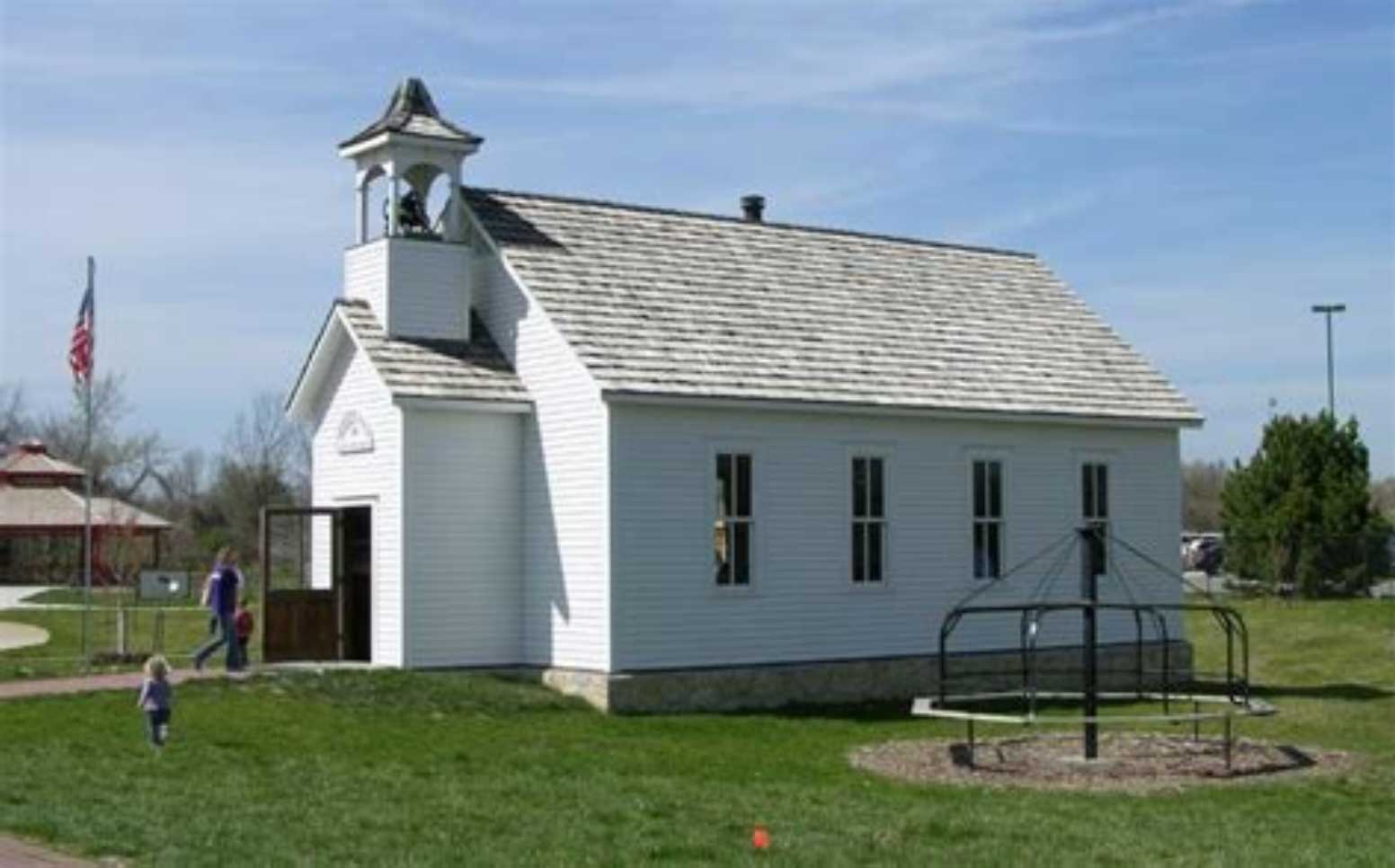
The one-room schoolhouse at Deanna Rose Children’s Farmstead in Overland Park, KS, allows kids of all ages to visit the past. (Image courtesy of Deanna Rose Children’s Farmstead)

Author Laura Ingalls Wilder’s “Little House on the Prairie”

Author Laura Ingalls Wilder’s “Little House on the Prairie”

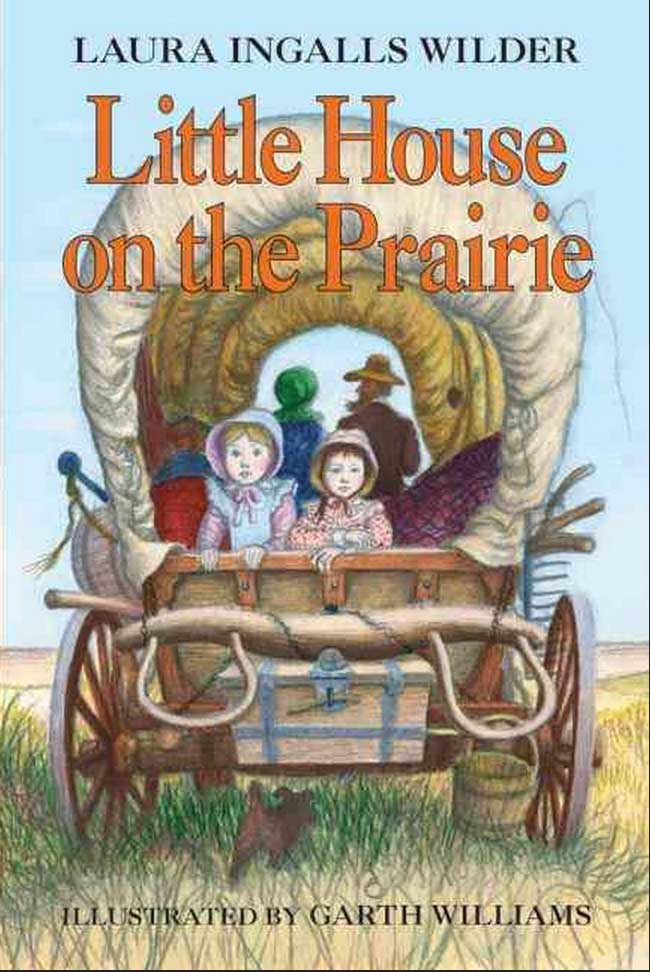
Author Laura Ingalls Wilder’s “Little House on the Prairie” series painted a vivid picture of life inside a one-room schoolhouse in the 1800s. (Image courtesy of Ebay)

Fourth-graders visit a one-room schoolhouse

Fourth-graders visit a one-room schoolhouse

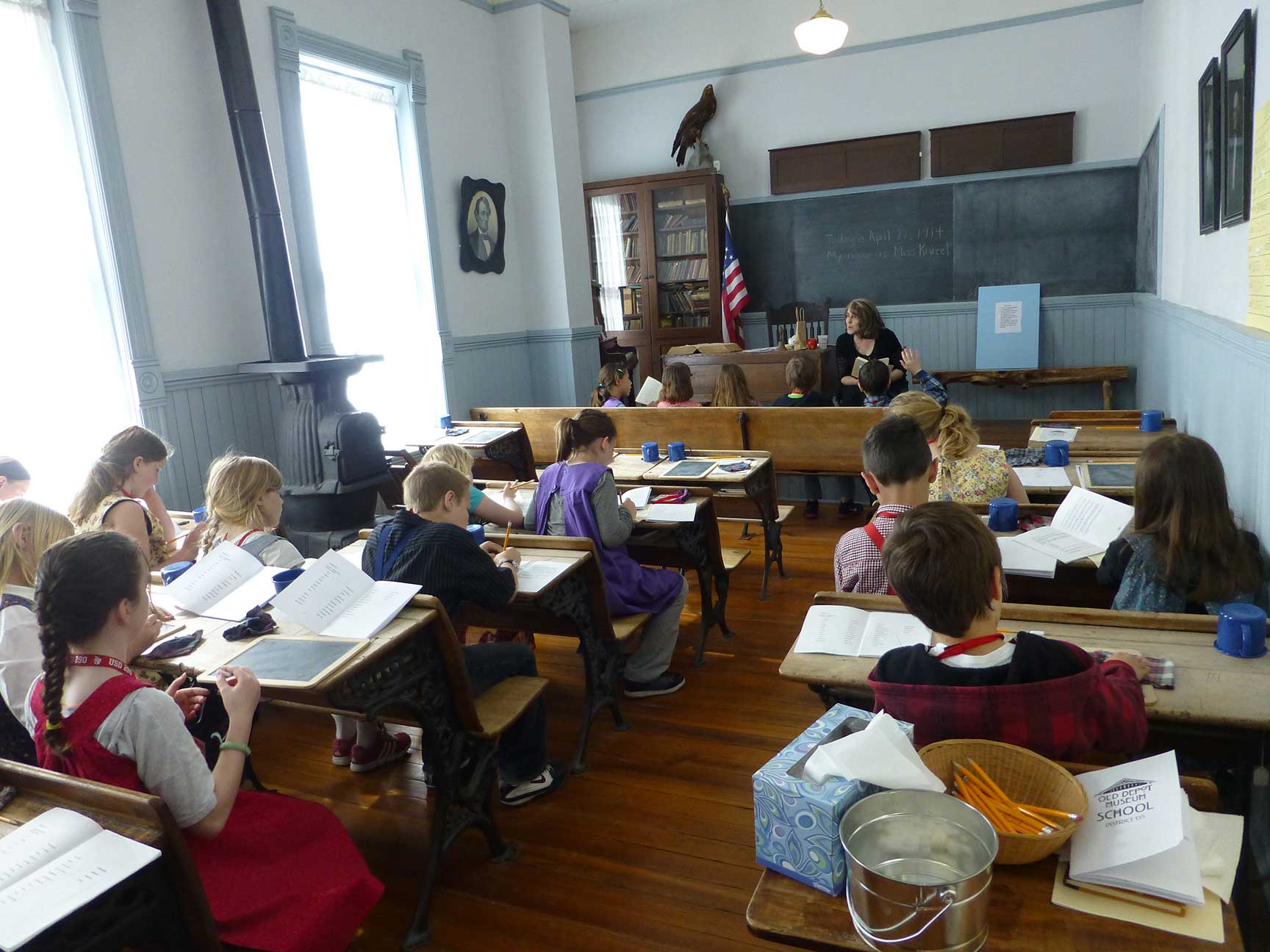
Fourth-graders visit a one-room schoolhouse in Ottawa, KS, to get a glimpse of how students received their education in the early 20th century. )Image courtesy of The Old Depot Museum)

“When I was your age…”

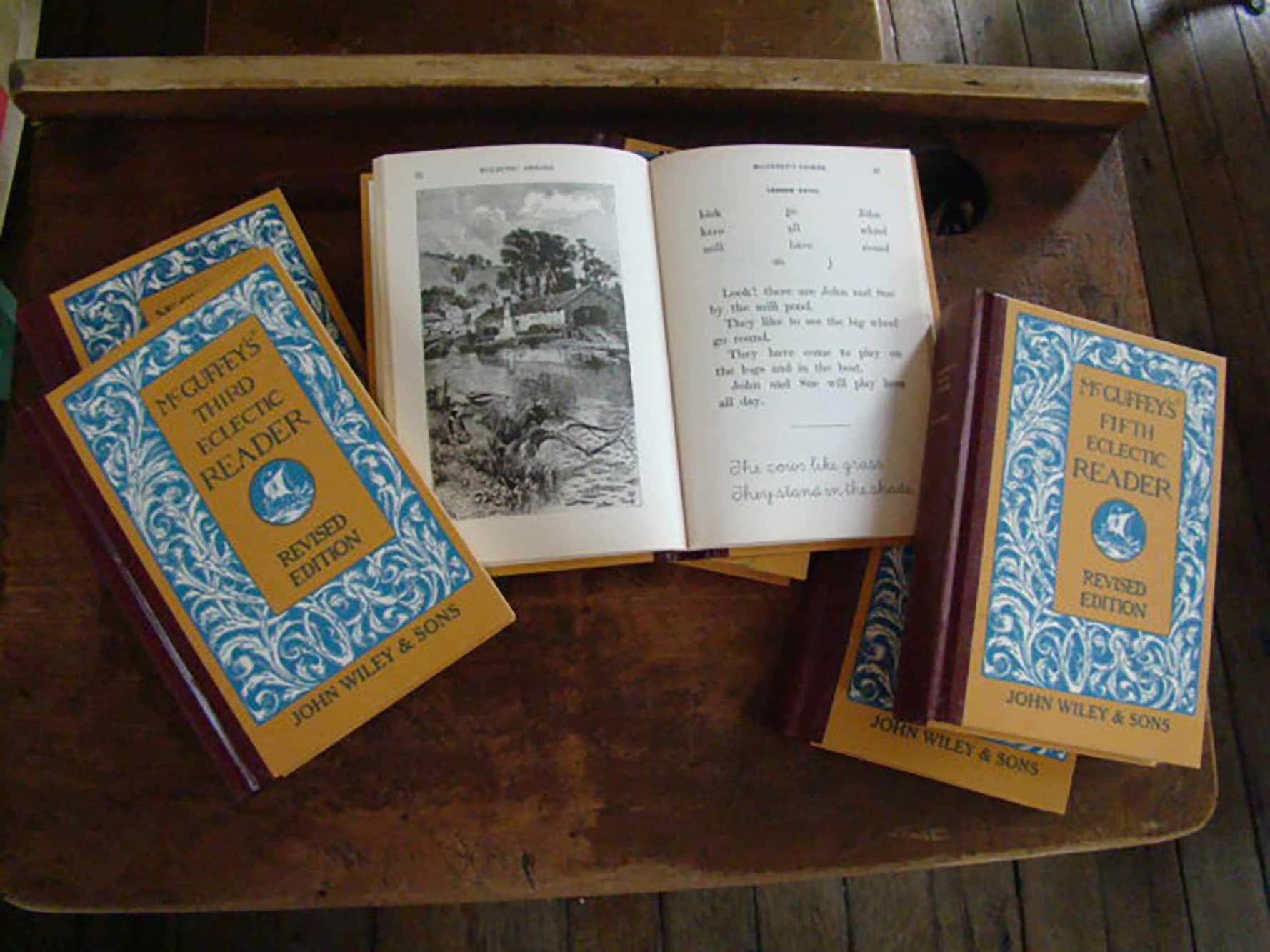
Students in one-room schoolhouses likely would have learned from The McGuffey Reader, first published in 1836. The readers taught students from grades 1-6 how to read using the phonics method and heavily utilized the slates and chalk that each student received at the beginning of the academic year in requiring students to replicate certain sentences or other vocabulary words.

The separation of religion and education was still a distant concept during the time of the one-room schoolhouse. In addition to the McGuffey Readers, students also learned reading from the Bible, which their teacher used alongside other teaching aids. In fact, many teachers opened their school day by leading the students in prayer, according to the Fort Hays (KS) State University Archives, which published an oral history project in which former students and teachers from schoolhouses in the region were interviewed about their experiences.

The earliest McGuffey Readers incorporated passages on national unity, piety and righteousness, and some remain in use today in evangelical Christian homeschooling, author Johann Neem writes in the summer 2018 edition of The Hedgehog Review.

No matter what their school day was like, Forbes’ Busteed says, those studious children grew up into the parents and grandparents who lightly admonished their kids and grandkids by reminding them how privileged their educational experiences are and saying, “When I was your age, I had to walk miles to school in the snow.”

“To this day, he loves sharing stories about it with his grandchildren,” Busteed says of his grandfather, “mainly bragging about how he had to ride his pony several miles to school (including through severe snowstorms).” 

Closures of schools continue, but lessons remain

Though class hasn’t been in session at most one-room schoolhouses for many decades, some 200 remain open to mold the young minds of students in remote areas, according to the U.S. National Register of Historic Places.

But those schools struggle to remain open, many instead being absorbed by other school districts nearby as families move to more populated areas for better job opportunities. One such school was the Glen School in Sioux County, NE, which had only three students enrolled as of a decade ago. NPR’s Neenah Ellis first visited the school in 2005 and met the last three students attending the school.

“The boys at the school -- Travis, Luke and Nick -- were all the sons of ranchers, their futures more secure than most,” Ellis shared in her broadcast on NPR. “But still, in just a few years, when they graduate from high school, these boys will be faced with hard decisions: Do we stay and work the ranch, or do we leave? And if we leave, can we come back?”

Contemporary students get to hear voices from the past

Contemporary students get to hear voices from the past

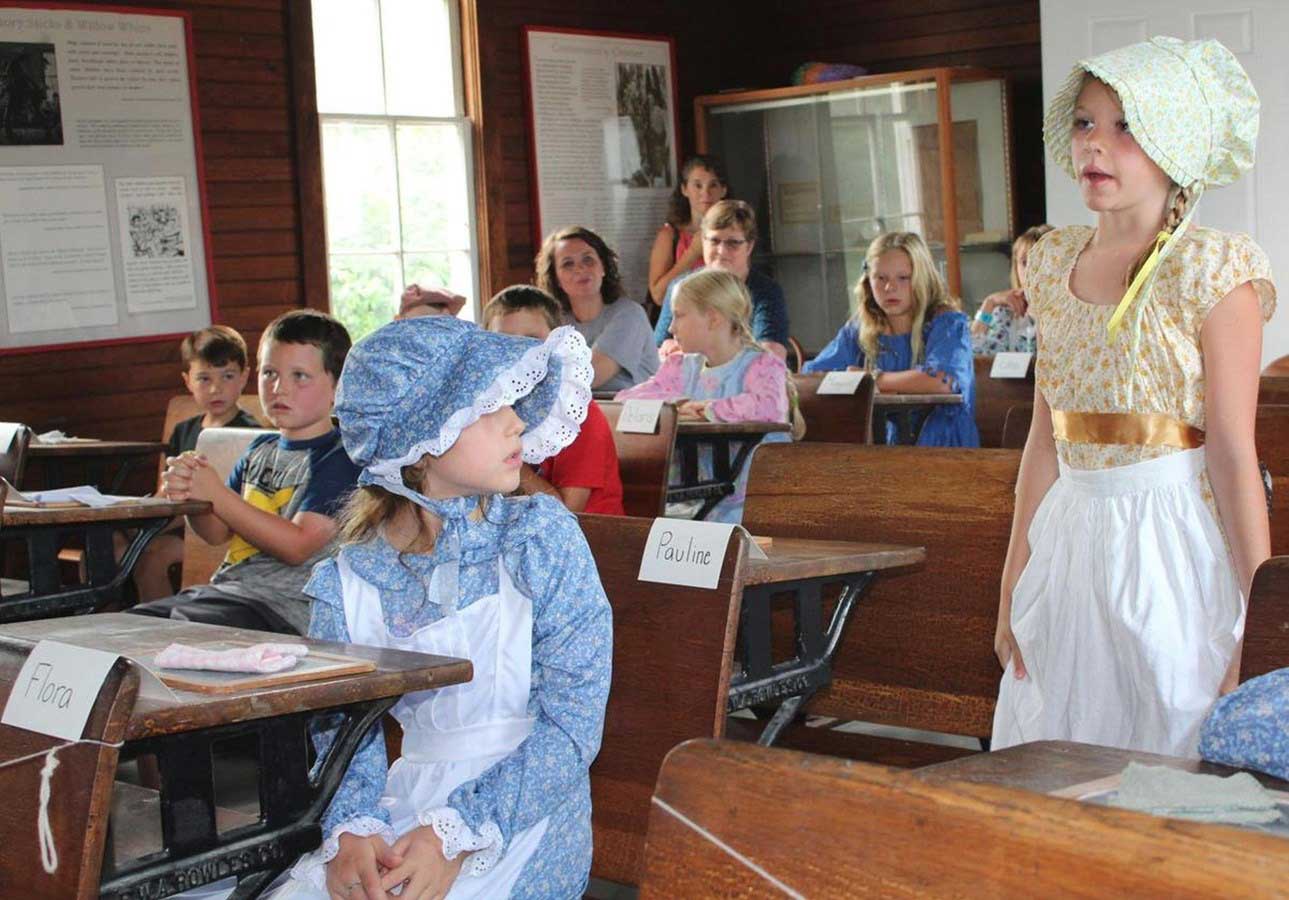
Contemporary students get to hear voices from the past while visiting the one-room schoolhouse in Hensley Township, IL. (Image courtesy of Museum of the Grand Prairie)

The Bichet School

The Bichet School

The Bichet School, built in 1896 and located in Marion County, KS.
(Image courtesy of Wikipedia)

The Glen School’s lone teacher, Mori Hourt, had many of the same responsibilities as an educator at a larger school – “It’s her job to get the boys ready to move on, whether that means high school, college or something else,” Ellis writes.

Within mere months of Ellis’ first visit to The Glen School, the decision came down from the school board to shutter the school. It closed in 2006, one of the last few remaining in the rural farming communities across the nation.

“After 120 years, there would be no school in Glen,” Ellis writes in the conclusion of the article that accompanies her broadcast. “The boys would finish in town. … No one was surprised at the closing of Glen School. They’d all seen it coming for a long time.”

Although the number of one-room schoolhouses continues to shrink every year, the students of today can still indulge in a taste of what life was like for those students of yesteryear. The Old Depot Museum in Ottawa, KS, for instance, allows students to tour the Franklin County one-room schoolhouse and replicate a typical day in the life of a student in 1910. Students dress in period-style clothing, with girls wearing pinafores and boys in suspenders. They recite the Pledge of Allegiance to start their day and receive lessons in subjects like reading, penmanship and music. They even use traditional pens and inkwells, as well as slates for their lessons.

It’s all a part of keeping the culture of one-room schoolhouses alive for children and history buffs alike as trends in education evolve and change, says Mori Hourt of The Glen School.

“You know, I think eventually education is going to have to stop and look at the example set by a one-room school and say, ‘Oh, my, maybe they weren’t deprived,’” Hourt said. “Many, many things have been done correctly in a one-room school and the results are there to read in history, if you just turn the right page.”

The McGuffey Reader

The McGuffey Reader

The McGuffey Reader was the gold standard for teaching students in one-room schoolhouses how to read throughout the 19th century. (Image courtesy of Etsy)

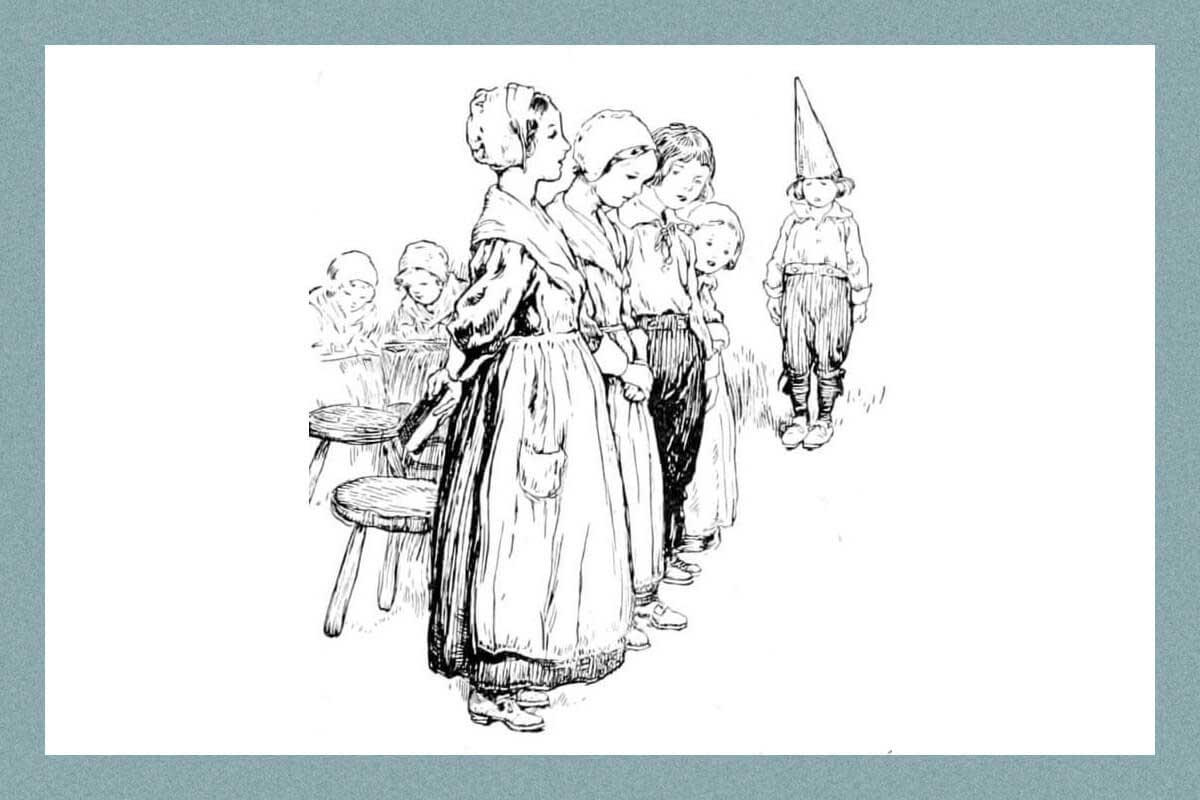
student wearing a dunce cap

Student wearing a dunce cap

The idea of a misbehaving student wearing a dunce cap and sitting in the corner originated in the one-room schoolhouse, according to Ancestry.
(Image courtesy of Ancestry)

Summer al fresco Before packing up a seasonal picnic, feed your head with these historical facts

Summer al fresco Before packing up a seasonal picnic, feed your head with these historical facts

Photo by Mike Leavenworth on flickr

July 2022

Cover Story

Summer al fresco

Before packing up a seasonal picnic, feed your head with these historical facts

by Corbin Crable

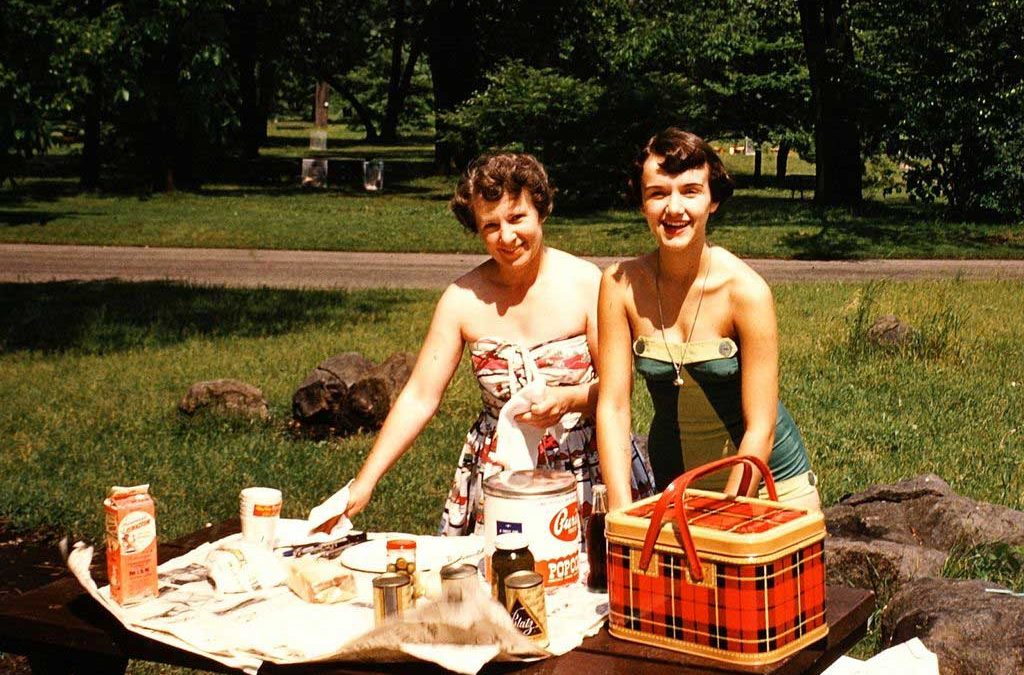
One of the great joys of pleasant weather lies in the simple picnic, a summer activity whose history is as varied as the lunch offerings to be found there. The late cook and renowned foodie James Beard put it well when he observed that “picnicking is one of the supreme pleasures of outdoor life.”

Before the advent of the very word ‘picnic’ itself, according to May 26, 2013, NPR broadcast, picnicking as an activity could be found in the medieval lore of Robin Hood and his Merry Men, who traveled through the depths of Sherwood Forest, dining informally on bread and cheese – washed down with ale, of course.

An aristocratic activity

The origins of the word ‘picnic,’ meanwhile, are up for debate, but what we do know for certain is that it first appeared in a French satire in which the primary character, named ‘Pique-Nique,’ is presented as a gluttonous protagonist who led a revolution against the ruling class in 17th-century France. Since he was known for eating large, lavish meals, Pique-Nique’s name, which literally translates to “To peck a small amount,” was an exercise in irony.

In the 1700s, enjoying a picnic was an activity indulged in mostly by aristocrats, who requested that attendees bring an item to share, such as a beverage. If they wished, attendees could opt not to bring anything to share, but they could help pay a portion of the overall cost of the picnic instead. At these picnics, while servants would dish out the food and drink, the aristocrats especially enjoyed the wit and rich conversation of their peers, so the picnic was viewed as an activity for the refined and educated. Playing music also was a common accompaniment.

1972 Dark Side of the Moon Tour

Your drink selection is sure to be the centerpiece of your picnic

Whether you opt for a wine, a fruity cocktail or a traditional lemonade, your drink selection is sure to be the centerpiece of
your picnic. (Image courtesy of Our Table)

“The original definition of the word ‘picnic’ denoted something like a potluck, so you would have a bunch of people getting together, and each would be contributing to the feast,” food historian Lynne Olver told NPR in the 2013 broadcast.

The face of the picnic changed completely during the French Revolution, when members of the aristocracy immigrated to England and, their fortunes shattered by the conflict, tried to adapt and maintain their former quality of life.

“This led to two important developments,” according to a 2019 article written by Alexander Lee and published in the periodical History Today. “The first – and shortest-lived – was that, in London, the picnic became less refined and more raucous. This was thanks to a group of 200 wealthy young Francophiles, who – in late 1801 – founded the ‘Pic Nic Society’. Held in hired rooms in Tottenham Street, their gatherings were self-consciously extravagant. Every member was required to bring a dish (decided by lot) and six bottles of wine.”

Who ever heard of an indoor picnic?

Until the early 1800s, picnics were held exclusively indoors. With the dawn of the new century came the activity’s move to outdoors. It would be another 100 years – the early 20th century – before outdoor picnicking became more popular than the indoor version.

“What caused this change is somewhat unclear, but the most likely explanation is that the socially aspirational simply applied a fashionable French word to a pre-existing practice, without being aware of its connotations,” Lee writes. “One of the results of this was that picnicking ceased to be associated with music and dancing and became a simple meal to which people were invited by a host. Another was that it became both more ‘genteel’ and – thanks to the idealisation of the countryside – more innocent.”

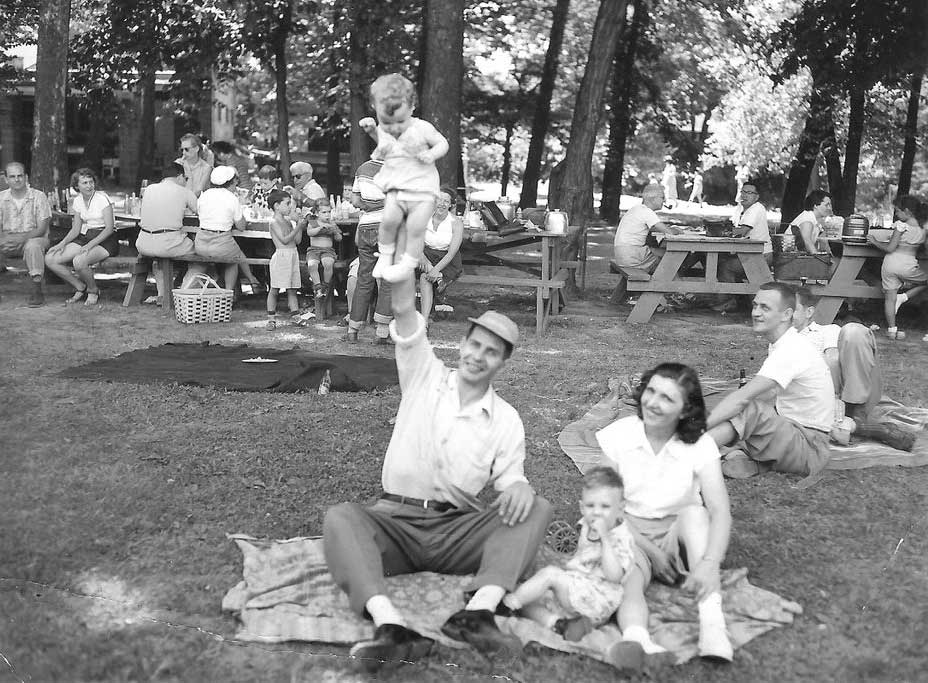
Perfect picnic – the ingredients are merely food and fun.

The perfect picnic – the ingredients are merely food and fun

Always remember that there’s no hard and fast rule to making the perfect
picnic – the ingredients are merely food and fun. (Image courtesy of Reader’s Digest)

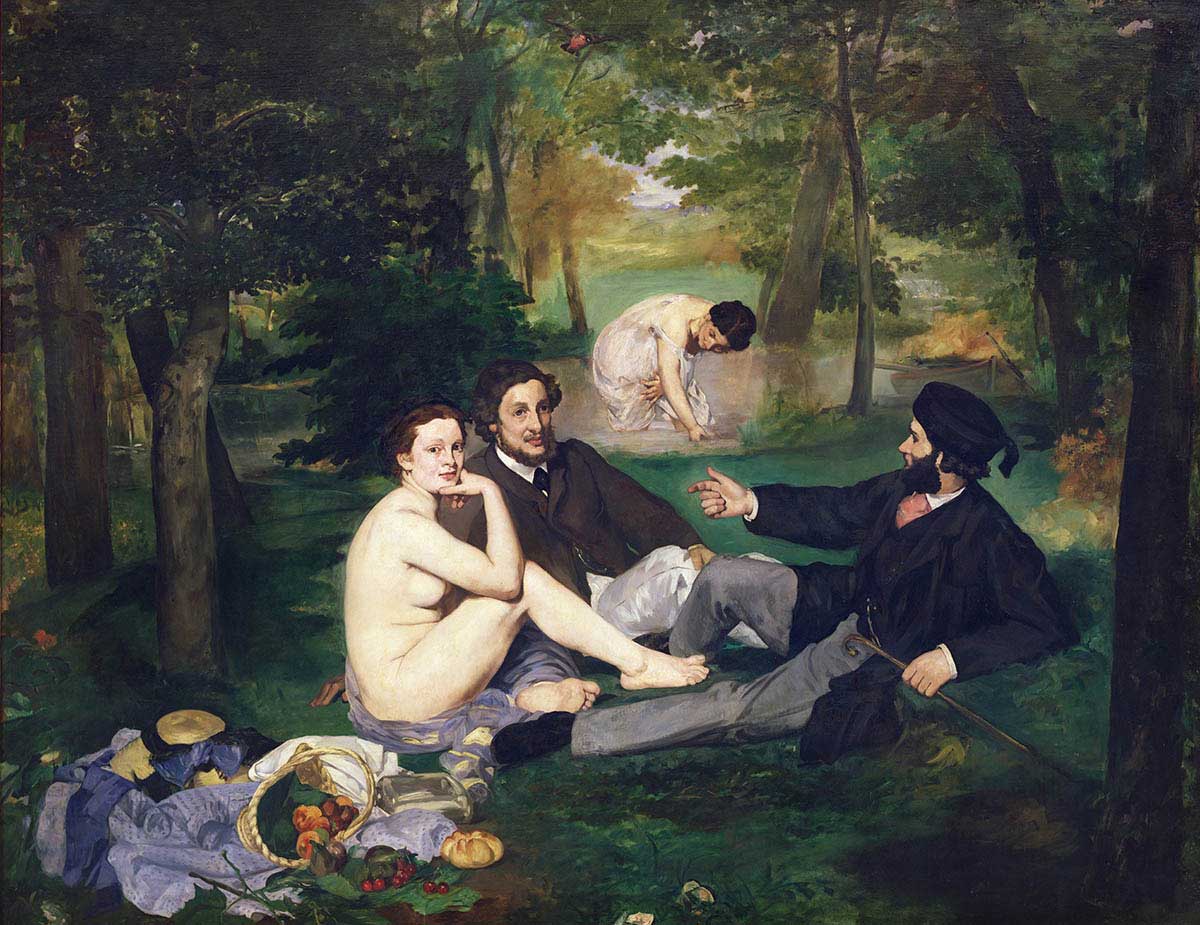
Portrayed the picnic as a hedonistic activity

Portrayed the picnic as a hedonistic activity

Edouard Manet’s “Le Dejeuner sur l’herbe” (1862) portrayed the picnic as a hedonistic activity. (Image courtesy of Bridgeman Images)

Sin vs. simplicity

Surprisingly, picnics were a moral issue in the 18th and 19th centuries, when they found their way into both the visual and written arts; though paintings, poems and novels portrayed the picnic as a celebration of innocence and simplicity in life, others still showed the picnic as decadent and hedonistic, such as the nude picnicker in Manet’s “Le Dejeuner sur l’herbe” (1862).

In Victorian England, if one were having a picnic outside, according to the NPR broadcast, one had to include “tables, linens, crystal, chairs and servants – and gourmet fare, of course.”

Author Katherine Mansfield, in her blog The Vintage Kitchen, writes that as picnics moved outside and became more casual, the look and the food that accompanied the activity changed drastically.

“Back in earlier centuries, outdoor eating meant bountiful quantities and dramatic fare. Whole animals roasted over fire pits, multiple courses served by domestic staff, exotic ingredients, rich foods, elaborate presentation,” Mansfield writes. “But as outdoor dining began to evolve over time into smaller parties and simpler affairs, the food that accompanied it changed also. As serving staffs diminished and people became more independent, picnics and the baskets they represented, became simpler – filled with foods that could be easily made, easily transported, and easily unpacked.

Economical, spontaneous, and available to everyone, picnics naturally turned destinations into dining opportunities. All you needed was a basket, a blanket, a small collection of foodstuffs, and an adventurous spirit.”


A tisket, a tasket, a picnic basket

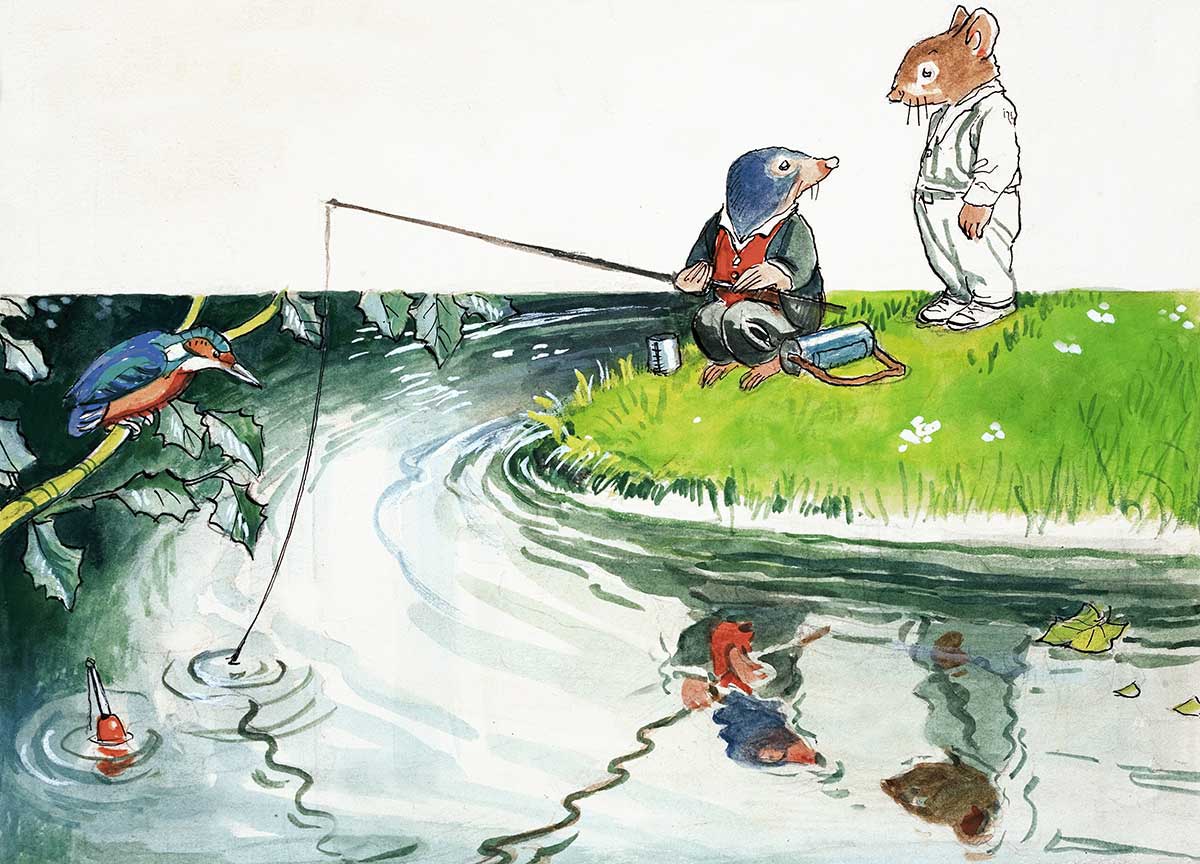
And as the 19th century gave way to the 1900s and the pioneering invention of the automobile made the countryside and nature more accessible to those wishing to enjoy a picnic, merchants began to produce baskets in which picnickers could carry their bounty. Around the time when British novelist Kenneth Grahame’s animals dined from a picnic basket in “Wind in the Willows” (1908), the picnic basket (also referred to as a “picnic hamper”) was invented.

“Picnic basket kits as we know today — having placeholders for dishes and silverware and glasses and napkins — actually begin to appear at the very dawn of the 20th century,” NPR’s Lydia Zurow writes.

Antique and vintage picnic baskets, usually made from woven wicker (though aluminum picnic baskets began to be manufactured in the mid-20th century in various colors), can be easily found online for less than $100. Sites such as Chairish.com have some options that cost up to $200, some with stenciled images or other embellishments.

Slow down, enjoy the finer things

Mansfield writes that when it comes to picnics, one thing that hasn’t changed throughout the centuries is an enjoyment of the finer things in life.

“The vintage-style picnic favors china plates and real glassware, classic cocktails and linen napkins, and most importantly, homemade food. It is the sort of affair that wraps you up in a long, restful lazy day adventure fueled with time-honored tradition and attention to detail. It discourages anything fast or obtuse- like technology and frenzied time schedules and plastic utensils,” Mansfield says. “It champions a slower, simpler and more relaxing rhythm. The type of experience that not only feeds your appetite but also your senses, your spirit and your sanity. Basically, a vintage-style picnic is a big, long break in your day meant for resting, relaxing and restoring through small details… the time-worn touch of an old plate, the taste of an heirloom recipe, the time-out of technology, and the tune in to your natural surroundings.

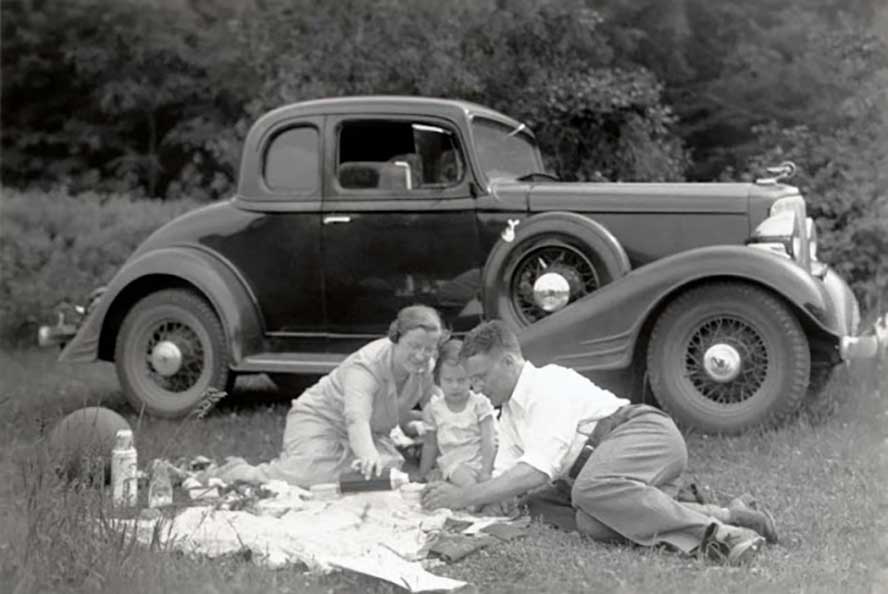
picnic in the countryside in 1933.

Picnic in the countryside in 1933

A family enjoying a summer picnic in the countryside in 1933. (Image courtesy of Vintage Everyday)

picnics in literature.

picnics in literature.

 Kenneth Grahame’s “The Wind in the Willows” (1908) is one example of the presence of picnics in literature. (Image courtesy of Philip Mendoza, Bridgeman Images)

your summer picnic basket

Your summer picnic basket

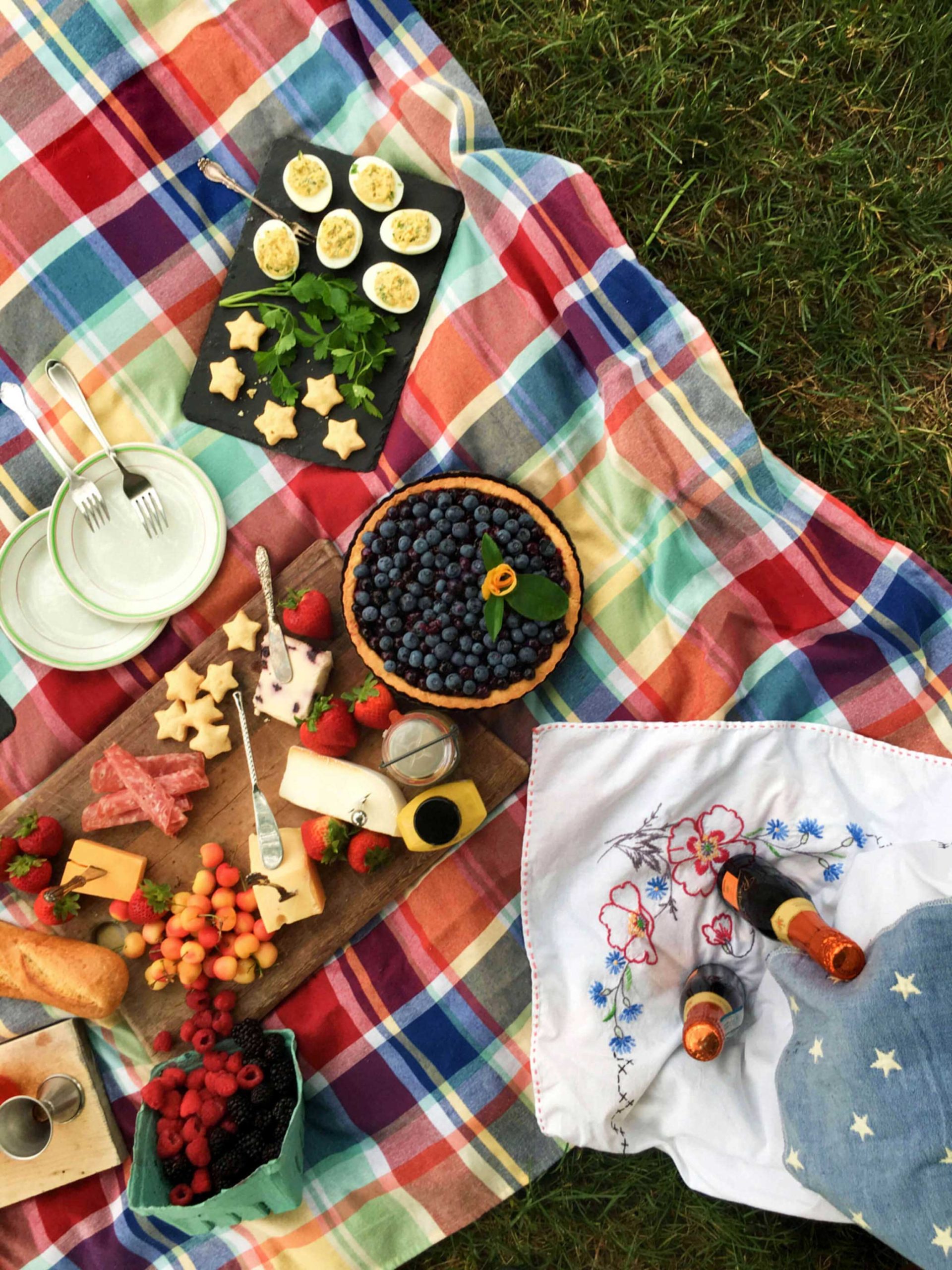
You can pack whatever you’d like into your summer picnic basket, but for a vintage picnic feel, you can include classic foods such as deviled eggs, fruit tarts and wine and cheese. (Image courtesy of In The Vintage Kitchen)

All the standard treats

Much like the location and look of picnics have evolved, so too have the foods enjoyed at such relaxing outings.
The types of foods that we commonly associate with a picnic fell into favor with picnickers in the mid-20th century, according to Mansfield.

“By the time the mid-20th century rolled around, there was a definite type of picnic fare anticipated and defined by the activity,” Mansfield writes. “Fried chicken, salads and deviled eggs topped the favorites list, along with hot dogs, sandwiches, pies, cakes, bread and fruit.”

Regardless of what you’re planning to nibble on, no matter where you’re planning to enjoy the great outdoors with a full picnic basket, Mansfield says there is joy to be found in a simple picnic, as its long history has shown.

“Eating is a ceremonial act,” she says. “The art of the vintage picnic reminds us of that. Just as it has in the past and will continue to do so in the future.” 


vintage-inspired picnic baskets

Vintage-inspired picnic baskets

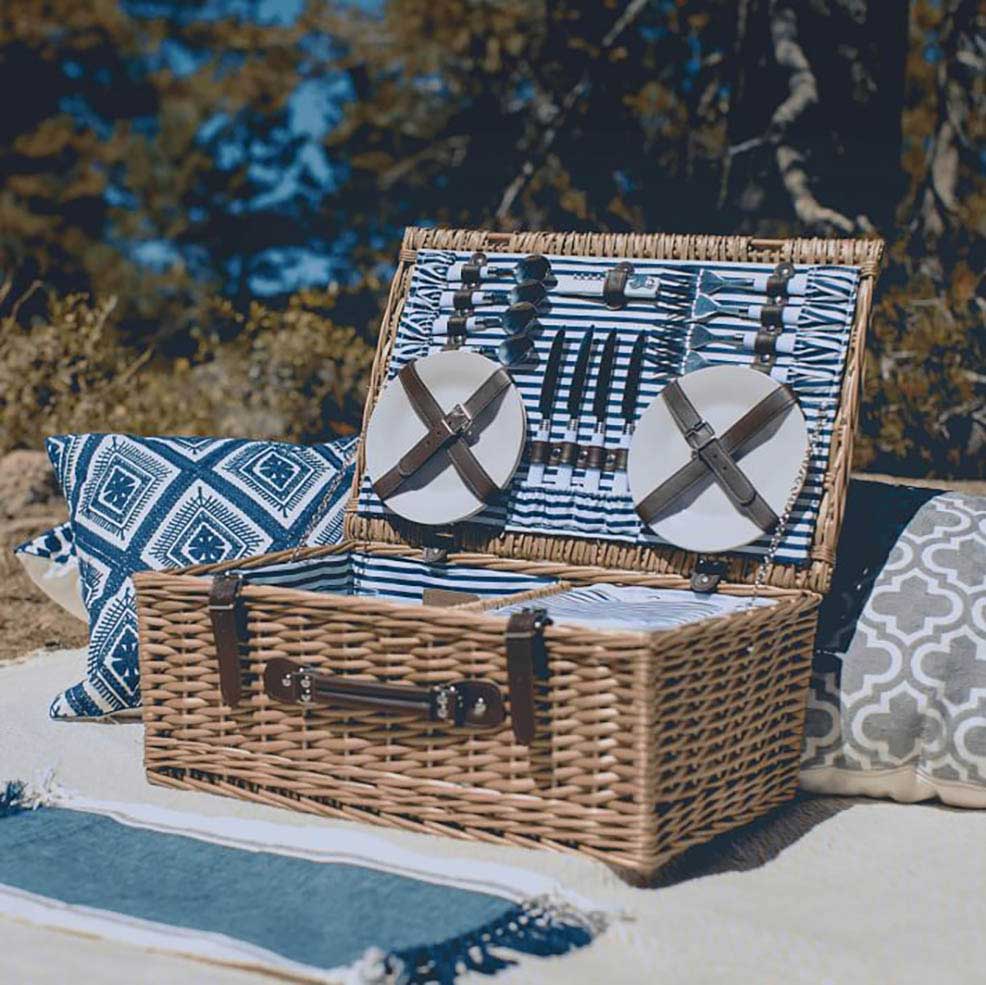
Vintage and vintage-inspired picnic baskets are readily available on websites like Etsy. They usually sell for around $100 or so. This basket, complete with place settings for two, sells for $100 on Westelm.com. (Image courtesy of West Elm)

Get into the groove  Vintage concert posters are collectible pieces of music history

Get into the groove Vintage concert posters are collectible pieces of music history

June 2022

Cover Story

Get into the Groove

Vintage concert posters are collectible pieces of music history

by Corbin Crable

Whether tacked onto the wall of a bar or plastered onto a streetlamp post, vintage concert posters announced small, intimate shows and big, earth-shaking cultural events alike – and years after the music has stopped, they remain fun collectibles, reminders of the soundtrack of one’s youth.

Record stores, antique shops, bars and restaurants display them prominently – both as colorful conversation starters and as decorations designed to get you in the mood for good times.

In the Kansas City metro area, vintage concert posters feature heavily into the interior decoration of at least three merchants. At BB’s Lawn Side BBQ, a perennial favorite for barbecue and blues, concert posters cover the interior walls of the restaurant known for a savory treat called the BBQ Sundae. Hastily affixed to the walls with large staples, the concert posters advertise blues and jazz musicians of bygone performances, giving the establishment a roadhouse feel.

“The décor is eclectic,” one reviewer wrote on Trip Advisor. “So much cool blues history and artwork.”

In the Kansas City suburb of Overland Park, Vinyl Renaissance has been keeping music lovers’ turntables active for more than two decades. Their store features not just a listening studio and wine tasting room, but also walls decked out in album covers and some concert posters. And on the other side of the state line, in St. Joseph, MO, St. Joseph Auction and Antiques boasts another large space called The Kool Kat Music Exchange where you will find walls decked out in vintage rock ‘n’ roll posters – and crateful after crateful of vinyl records just waiting to be sold to music lovers.

Collectible memories

And not only are these con- cert posters harbingers of nostalgia, of fun times from the not-too-recent past, but they’re increasing in value, too.

“Collectors are willing to pay a considerable premium for the prestige that comes with being able to display their rare acquisitions right on their walls,” says Glen Trosch, founder of the the Baltimore-based Psychedelic Art Exchange in a 2019 blog post. Trosch says he considers any “vintage” concert poster to be at least 50 years old.

Although early collectors of concert posters and other related art might have been only die-hard fans of the band or artist displayed, Trosch says the posters’ appeal has not only expanded to mainstream collectors, but art galleries and museums as well.

“Over the past several years, vintage rock concert posters have enjoyed major, highly successful exhibitions in many of our nation’s most prestigious museums, including The New York Museum of Modern Art, The San Francisco Museum of Modern Art, The Whitney Museum of American Art, The Laguna Art Museum, The San Diego Museum of Art, and The Smithsonian Institution,” he writes. “These exhibitions have been —and will continue to be—instrumental in broadening the awareness and appeal of vintage concert posters as millions of new people are exposed to their unique beauty, rarity, and historical importance.”

1972 Dark Side of the Moon Tour

1972 Dark Side of the Moon Tour

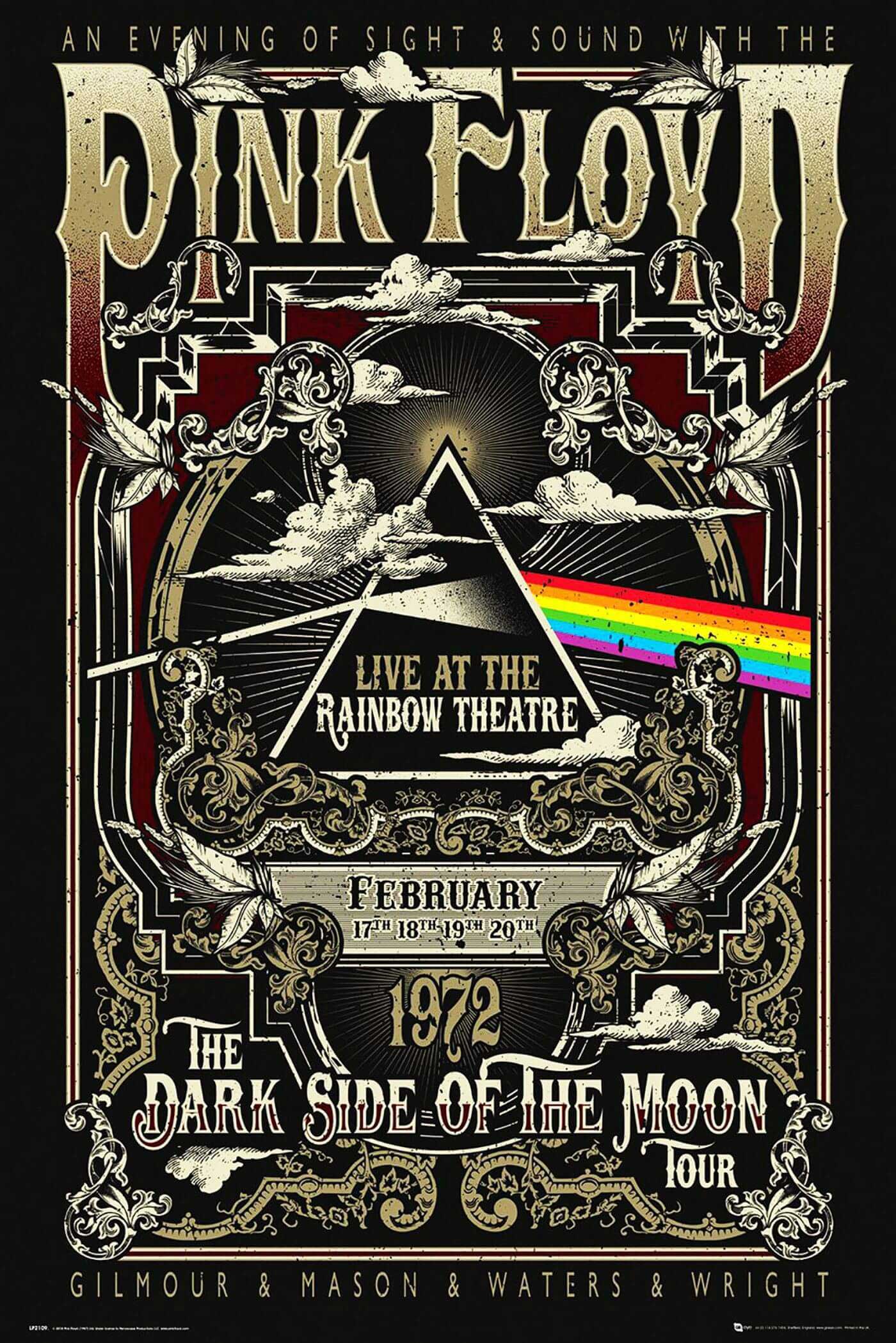
A poster advertising Pink Floyd during the band’s 1972 Dark Side of the Moon Tour.( Image courtesy of The Tallenge Store)

Art in the Age of Aquarius

Trosch says that currently, some of the most popular and sought-after vintage concert posters are those from the 1960s – after all, they’re eye-catching, colorful, and, well, psychedelic. Be ready to shell out some dough for mint-condition posters from the decade, however, as posters in pristine condition can be fetch thousands of dollars, and even those in fair condition can command prices in the high hundreds.

The value of such posters is so high because they were produced in such small numbers and because mint copies are rare – after all, Trosch says, posters are examples of ephemera, or items that are designed to last only a short time.

These works of art were initially produced as advertisements for live events. They were posted on telephone poles, bus stops, bulletin boards, store windows and other places all over town.

“After the event, they served no purpose, so they were quickly torn down and replaced with a new poster advertising the next big concert,” Trosch writes. “The only ones interested in this groundbreaking art were teenagers passionate about the bands and music, or hippies that were attracted to the poster’s cosmic visual appeal.”

Since these free spirits were the only ones collecting at the time, very little (if any) attention was paid to the state of preservation. Any knowledgeable collector will tell you that this is the primary factor in determining the value of any collectible. Very few of these works of art were carefully saved, and it is indeed a miracle that any have survived in mint condition today.”

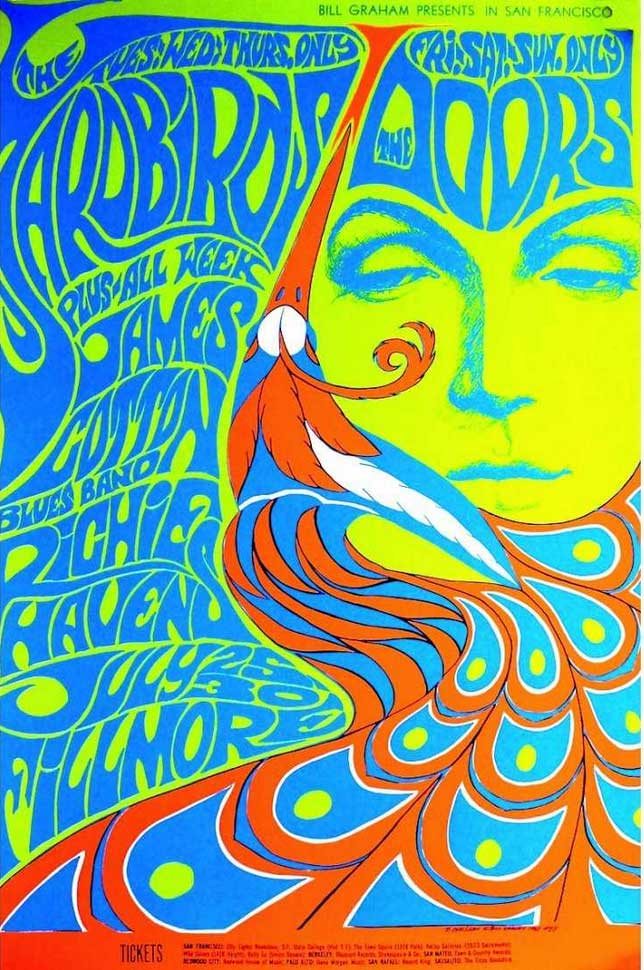
One of the most well-known posters produced in the 1967 Summer of Love was by artist Bonnie MacLean, advertising a joint concert from The Doors and The Yardbirds beginning on July 25 in San Francisco. Featuring striking, vibrant oranges and greens, the centerpiece image on the poster showed a peacock, with a woman’s face on the right side of the poster.

“The Yardbirds performed three days, The Doors performed three days, and all six shows featured the James Cotton Blues Band and Richie Havens,” Bill Graham, owner of Wolfgang’s, writes of the piece. “The serene visage of this maiden was a clear reference to the detached spirituality of the era.”


The Yardbirds and The Doors poster

The Yardbirds and The Doors poster

A 1967 poster advertising a joint concert between The Yardbirds and The Doors. (Image courtesy of liveauctioneers.com)

David Bowie concert posters

David Bowie concert posters

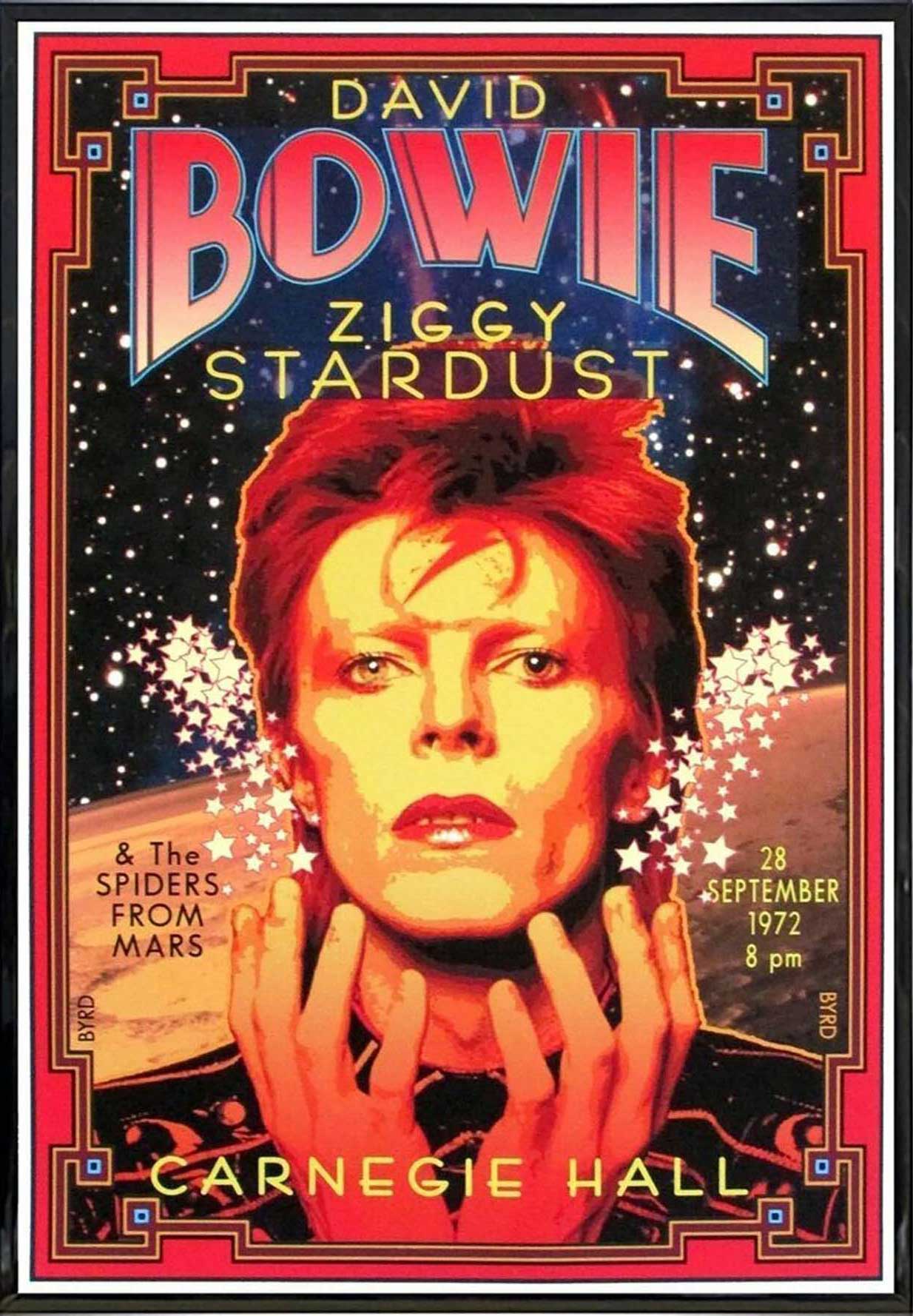
Many David Bowie concert posters of the 1970s displayed the musician portrayed as his alter ego, Ziggy Stardust. (Image courtesy of Notoriously Morbid)

Colorful lettering and images

Wolfgang’s sells original poster artwork of famed musical artists; Graham himself worked as a concert promoter for many years. Other posters by MacLean, a self-taught artist, include Jefferson Airplane (May 12); Martha and the Vandellas (May 19-20); Pink Floyd (Oct. 26), all from 1967 performances at The Fillmore Auditorium in San Francisco, the epicenter of the counterculture movement. Artist David Byrd, as The Fillmore’s exclusive concert poster artist, drew Jimi Hendrix at his peak in 1968 for The Jimi Hendrix Experience. On the other side of the country, color was splashed across the most popular concert posters of the 1960s and 1970s as they advertised artists playing New York City’s Radio City Music Hall. A Feb. 15, 1973, poster shows David Bowie as his androgynous alter ego Ziggy Stardust, while that same year, Pink Floyd was advertised as the headliner in concert there on March 17, during the band’s Dark Side of the Moon Tour (an original copy of that poster, listed in ‘poor’ condition, was recently sold at auction for $375).

Concert poster artists of the 1960s made liberal use of the Art Nouveau style, popular during the turn of the century. Their psychedelic posters, then, featured large, bulbous letters and sensuously drawn women, inspired using a little LSD, of course. According to Rachael Myrow of KQED Interactive Media, the Art Nouveau style “celebrated organic life: curling tendrils of vegetation, vivid colors, and lots and lots of curvaceous women.”

Individual artists and bands aside, concert posters also announced the arrivals of the 20th century’s biggest and best music festivals, chief among them the Monterey Pop Festival and Woodstock, arguably one of the most widely recognized concert posters ever created.

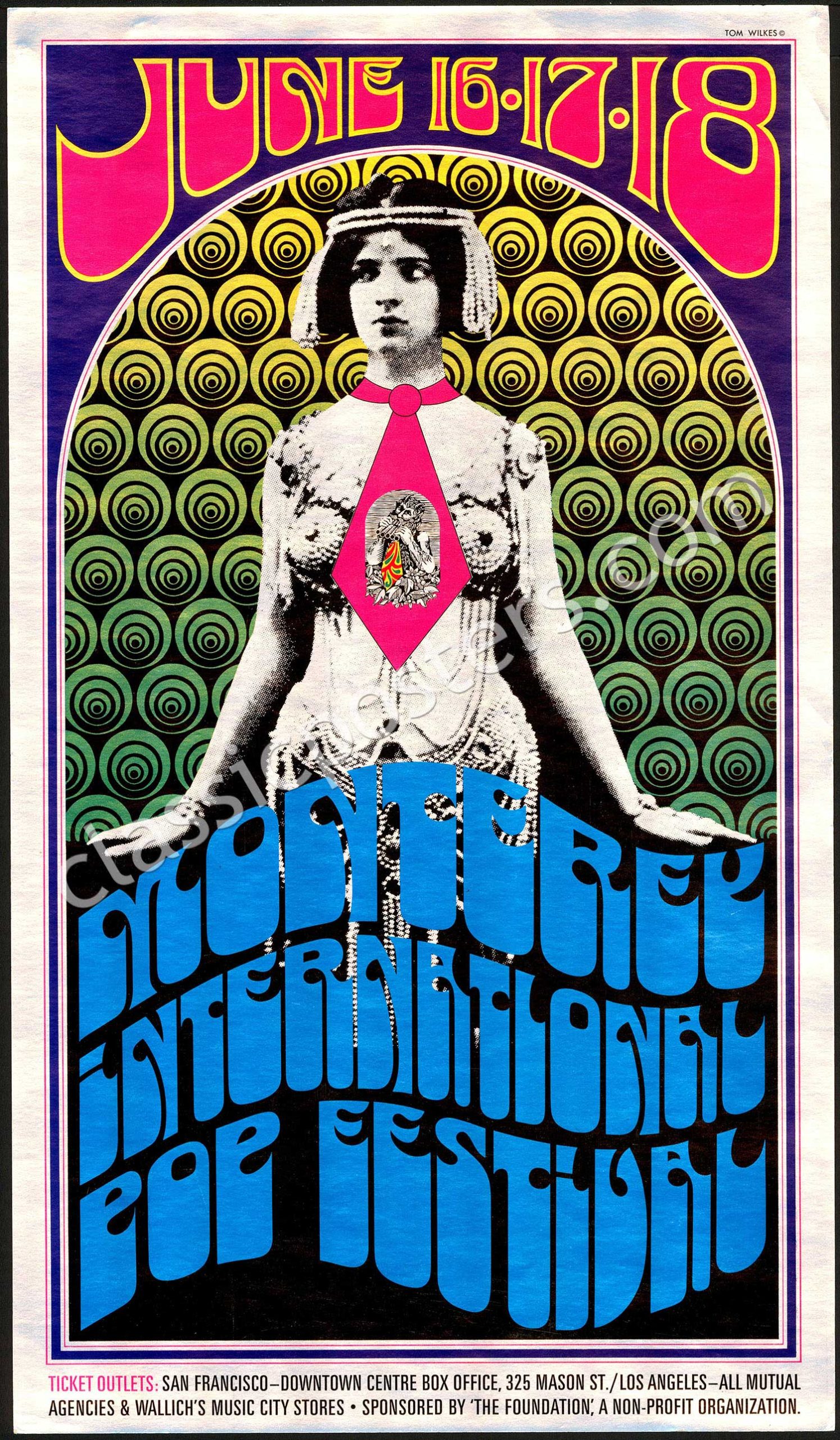
The three-day Monterey Pop Festival, from June 16-18, 1967, is considered to be one of the beginnings of the hippie/flower child movement; the festival boasted a lineup of musical giants, including Jimi Hendrix, Ravi Shankar, Janis Joplin with Big Brother and the Holding Company (still an up-and-coming talent), Otis Redding, and the Who. The poster itself features stage and silent film actress Maud Allen in costume as the biblical title character in the 1908 play “Vision of Salome.”

The Monterey Pop Festival

The Monterey Pop Festival poster

Art advertising The Monterey Pop Festival in the summer of 1967 mixed psychedelic lettering with a reference to silent film star Maud Allen. (Image courtesy of Lofty)

An iconic image

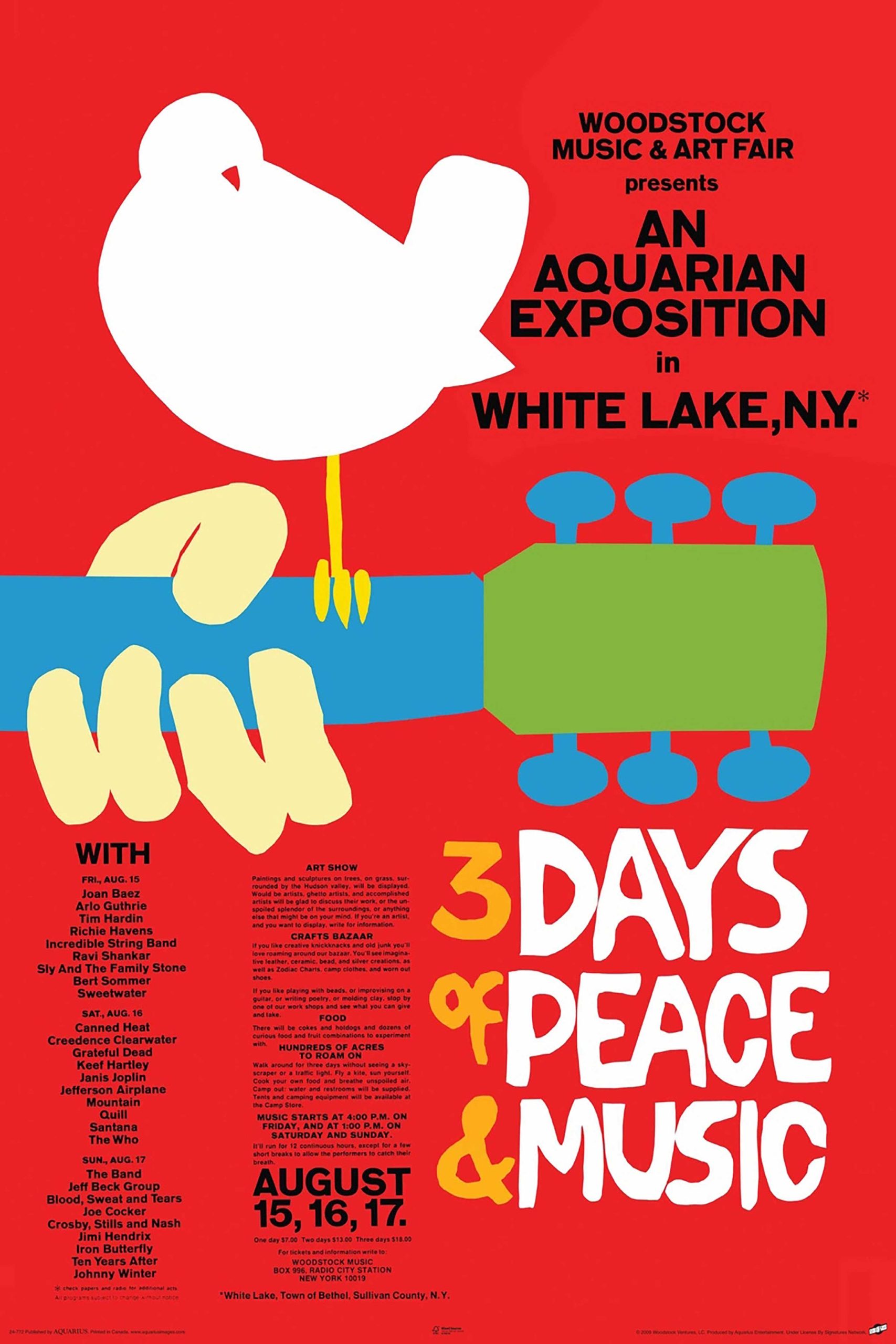
The poster advertising the August 1969 Woodstock Festival in Bethel, NY, now fetches nearly $7,000 for those original posters in mint condition, according to a 2019 podcast from New England Public Media, celebrating the 50th anniversary of the event.

Massachusetts artist Arnold Skolnick, the graphic designer who created the original poster while living in New York in 1969.

“(They) said, ‘We’re going to have a festival with arts and crafts and music,’” Skolnick recalled in his initial conversation with festival organizers. “And I turned it around to say, ‘three days of peace and music.’ So, it started with the words.’”

Unlike the elaborately designed psychedelic concert posters of the latter part of the decade, Skolnick decided that a simple design was better.

“Everybody was doing psychedelic posters, which I think are awful,” he said. “A poster is supposed to be so simple that if you’re driving by slowly in a car, you can see it.”

Skolnick’s finished product featured simple images – a guitar and a bird.

“I used a catbird instead of a dove, because a catbird is fat, and a dove is like a pigeon. It has no shape whatsoever,” Skolnick said. “When you say the word ‘peace,’ you think of a dove. It’s just a symbol.”

Skolnick’s iconic design was later incorporated into a monument at the site of the festival.


Woodstock concert poster

Woodstock concert poster

The design and the message of the iconic Woodstock concert poster are both simple and striking. (Image courtesy of Fine Art America)

Led Zeppelin poster

Led Zeppelin

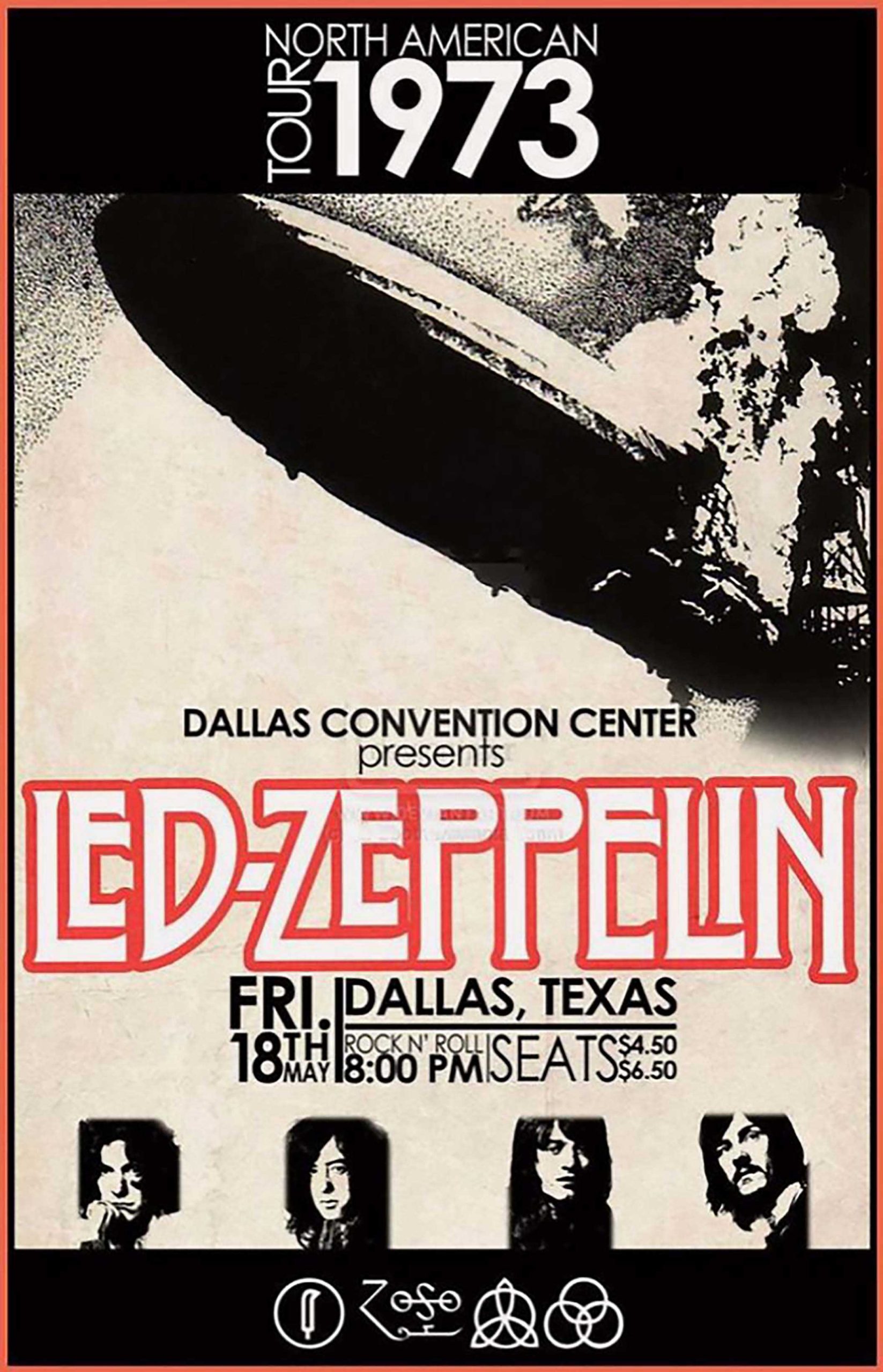
Rock legends Led Zeppelin traversed North America while on tour in 1973. (Image courtesy of Pinterest)

Collectibles you can afford

Trosch of the Psychedelic Art Exchange says that quite often, collectors just starting their collection don’t realize how affordable some vintage concert posters can be, making it easy to jump into collecting. And even better – these pieces document major gatherings in the history of music.

“These fantastic works of art are, without a doubt, the most authentic historical artifacts of this historical era. Unlike any other collectible or art in the world, they most closely represent and embody the ideals and values that helped shape our nation — then and now,” he writes. “For this reason alone, the appreciation and importance of these unique works of art are guaranteed to grow with each passing year.”

Your home away from home Vintage campers ready for summer adventures

Your home away from home Vintage campers ready for summer adventures

May 2022

Cover Story

Your home away from home

Vintage campers ready for summer adventures

by Corbin Crable

As temperatures grow warmer and nature calls out to you for yet another summer adventure, many longtime camping enthusiasts are gassing up their vintage campers and hitting the road.

The camper had been around since was invented in the 1930s as modes of transportation began an era of steady improvement. Although production of the camper slowed during World War II (the materials needed to be conserved for the war effort), campers exploded in popularity in the years immediately following the war’s end in 1945, as suburbs sprang up around the country and soldiers returned home to start their family.

Families who yearned for road trips enjoyed how cost-effective these campers were, and how they allowed travelers to bring their modern conveniences from home and drive right past roadside motels and travel lodges that dotted the landscape.

“Although camper travel meant pitching on road sides and traveling for long hours, it proved to be very cost-effective and a much more personal journey than on a train or plane,” according to the website classic-car-history.com.

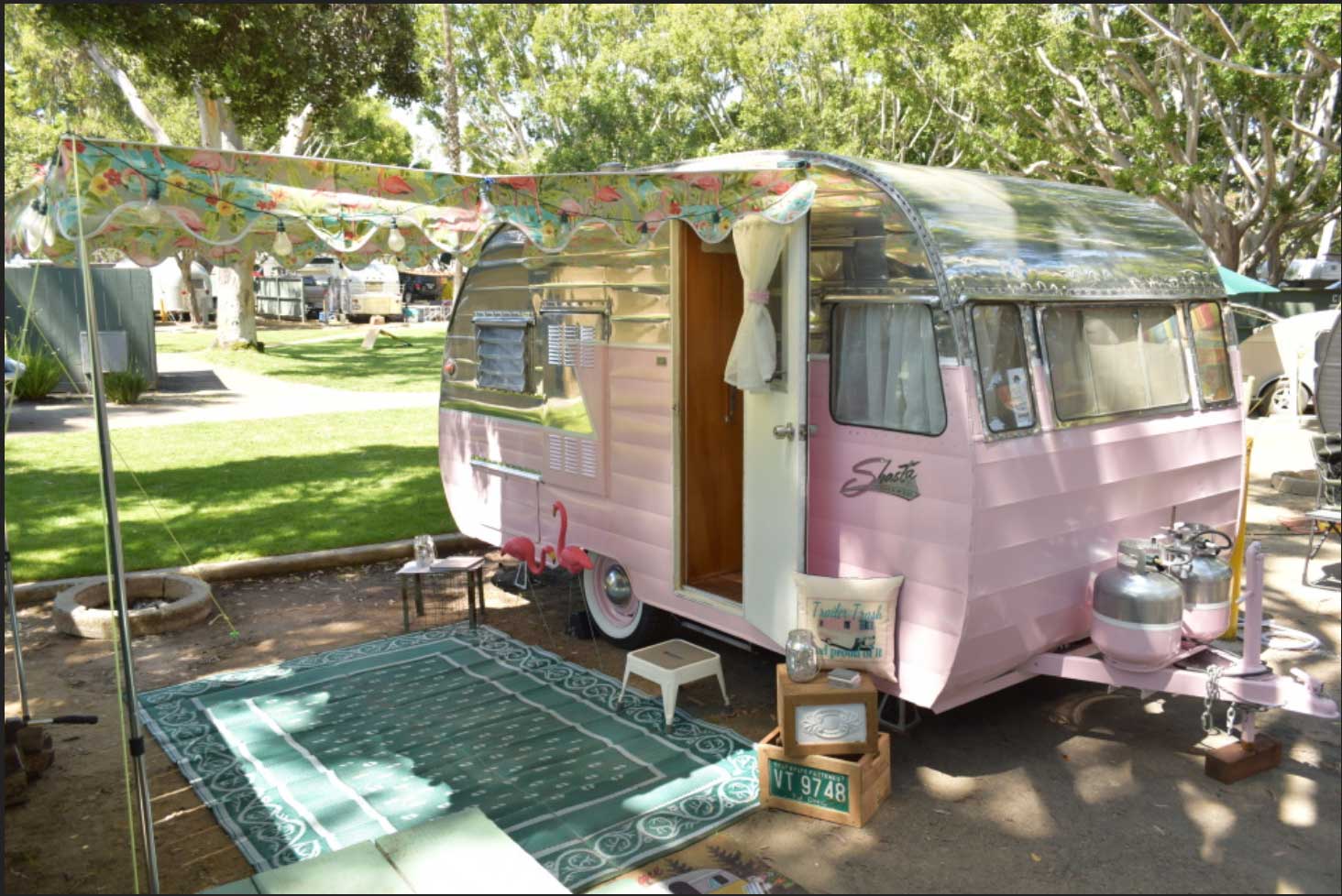
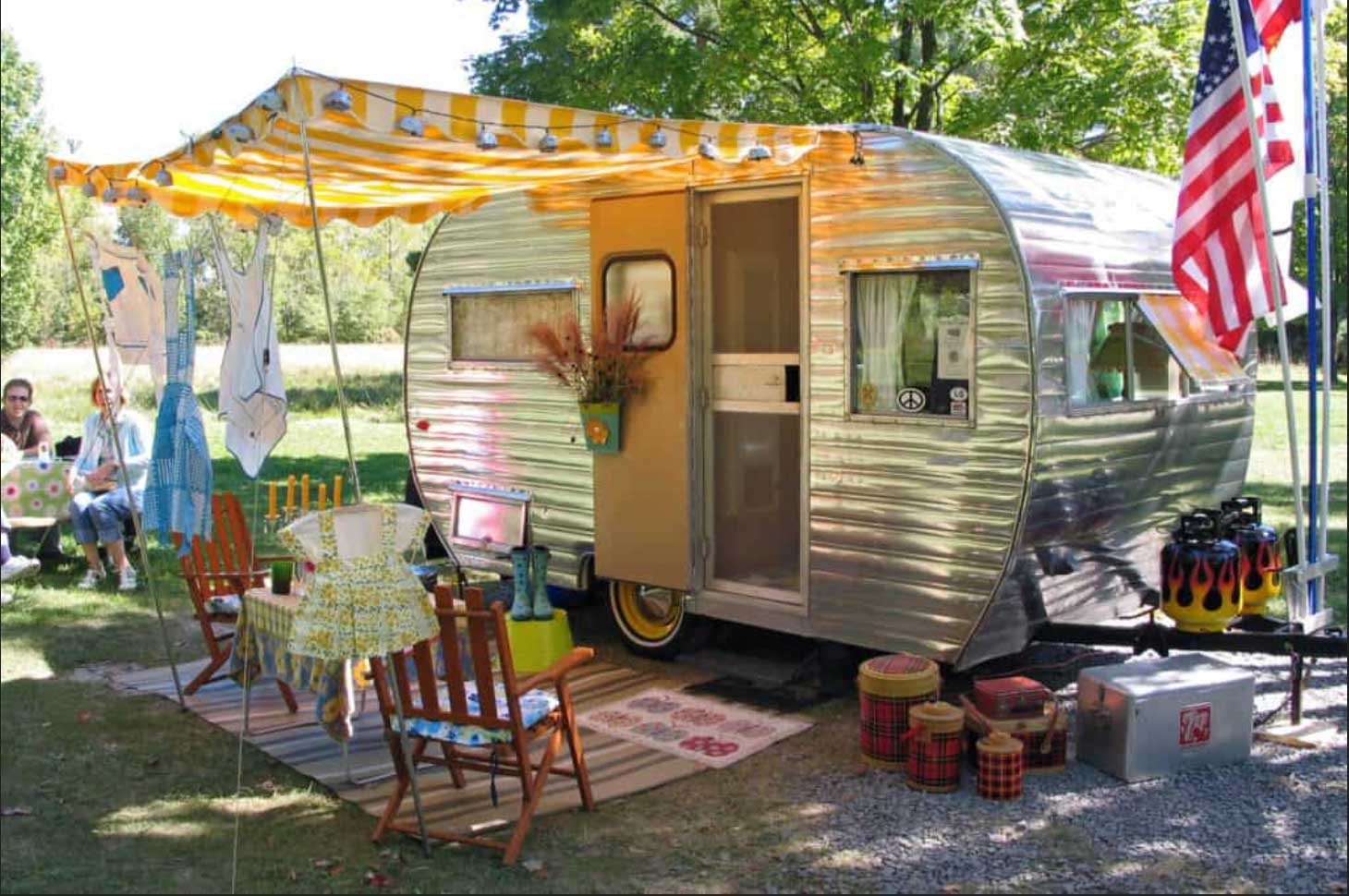
The plywood, aluminum, and fiberglass trailers bore names like DeVille, Shasta and Airstream, standing as a status symbol for middle-class Americans in the post-war years.

The camper has been called by many names over the years, but no matter what you call it, it serves the same purpose.

“Well, historically, they were all the same thing. Simply put, trailers. Even the industry was unsure if there were any differences,” Tom Heintz writes for Tin Can Tourists, a website for vintage trailer enthusiasts. “I have seen trailers as short as 16 feet called mobile homes and trailers as long as 35 feet called travel trailers by their own manufacturers in the 1950s and ‘60s.”

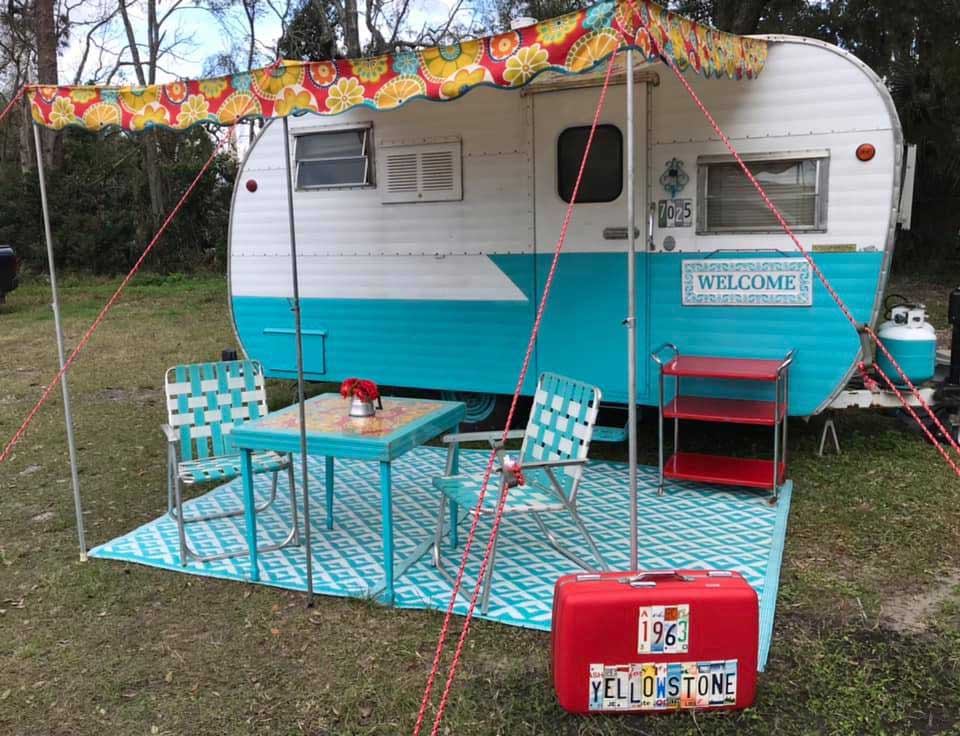
This 1963 Yellowstone camper is a fine exapmle of a Glamper Camper project. (Image courtesy of pinterest)

1963 Yellowstone camper

This 1963 Yellowstone camper is a fine exapmle of a Glamper Camper project. (Image courtesy of pinterest)

Teardrop trailers and onward

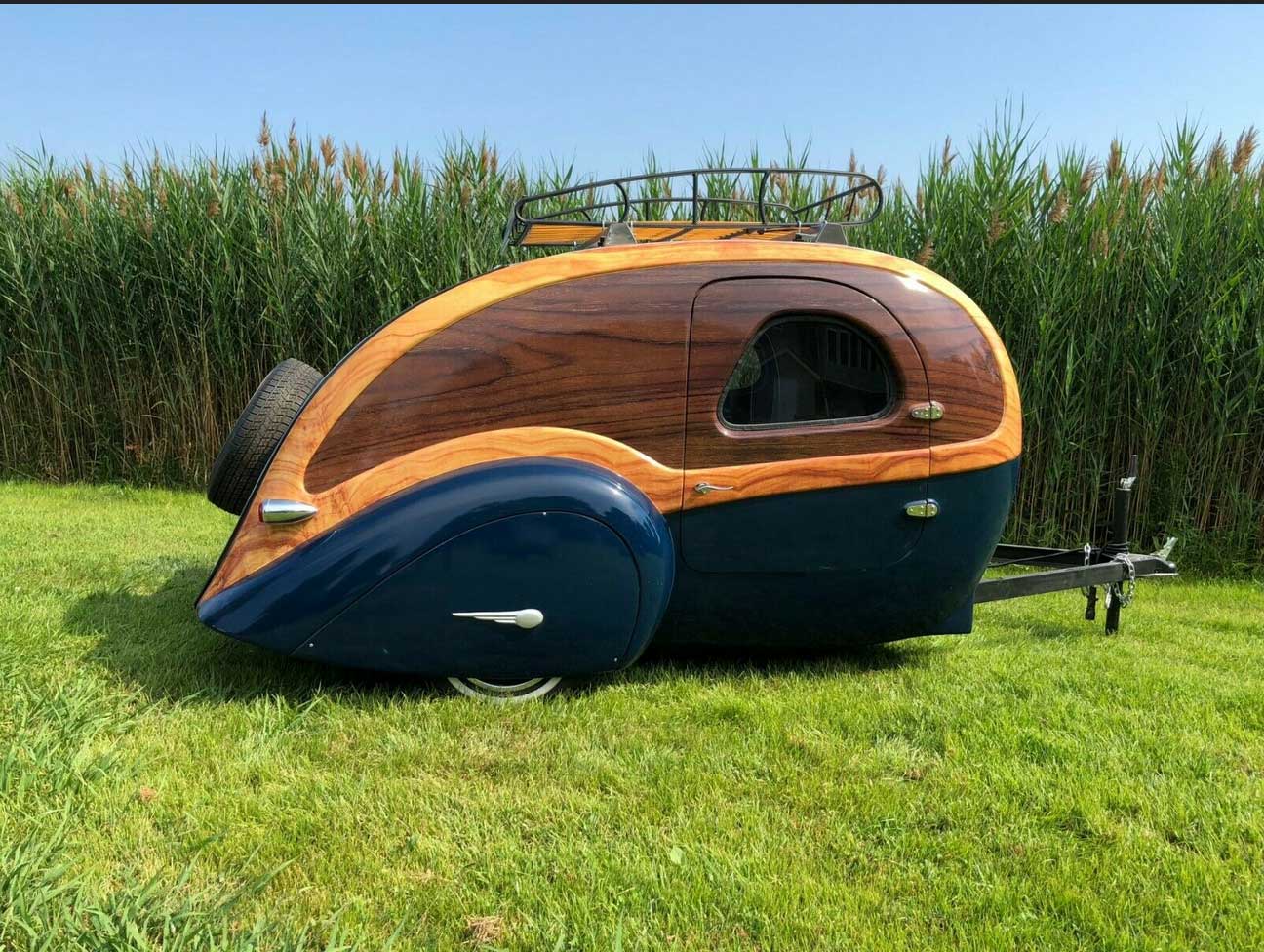
One of the more distinctive styles of vintage camper is the teardrop trailer, usually stretching out a mere 4 to 6 feet in width and 8-10 feet in length. Designed for only one or two campers, these trailers were sleek in design, their roofs made of curved metal and featuring pop-out back windows, according to the website. They remained popular for being compact, but declined in popularity throughout the 1950s as campers expressed a desire for more space for their growing family.

The modern-day “travel trailer,” or RV, and its many iterations proved to be more attractive to campers in groups. Older models didn’t have plumbing, but they did have features like wood-burning stoves designed to both cook food and heat the camper. The later vintage models, with a kitchen, a bathroom, and a sleeping facility, offered a way for families to camp out in style and with all of the modern conveniences of home in tow (some luxurious models included air conditioning, TVs, a water heater and quartz countertops as well). Though travel trailers had been around since the late 19th century, they, too, rose sharply in popularity in the mid-20th century as families grew and people had more disposable income.

RV parks began to spring up as campers enjoyed long-term time in nature. The decade of the 1950s saw added improvements in RV and camper technology, including lightweight construction techniques; more powerful gas and diesel engines were added which made RVs bigger and faster, according to The Caravan and Motohome Club.


restored vintage teardrop

Restored Vintage Teardrop

Here’s an excellent example of a beautifully restored vintage teardrop camper trailer. (Image courtesy of vehiclegeni.com)

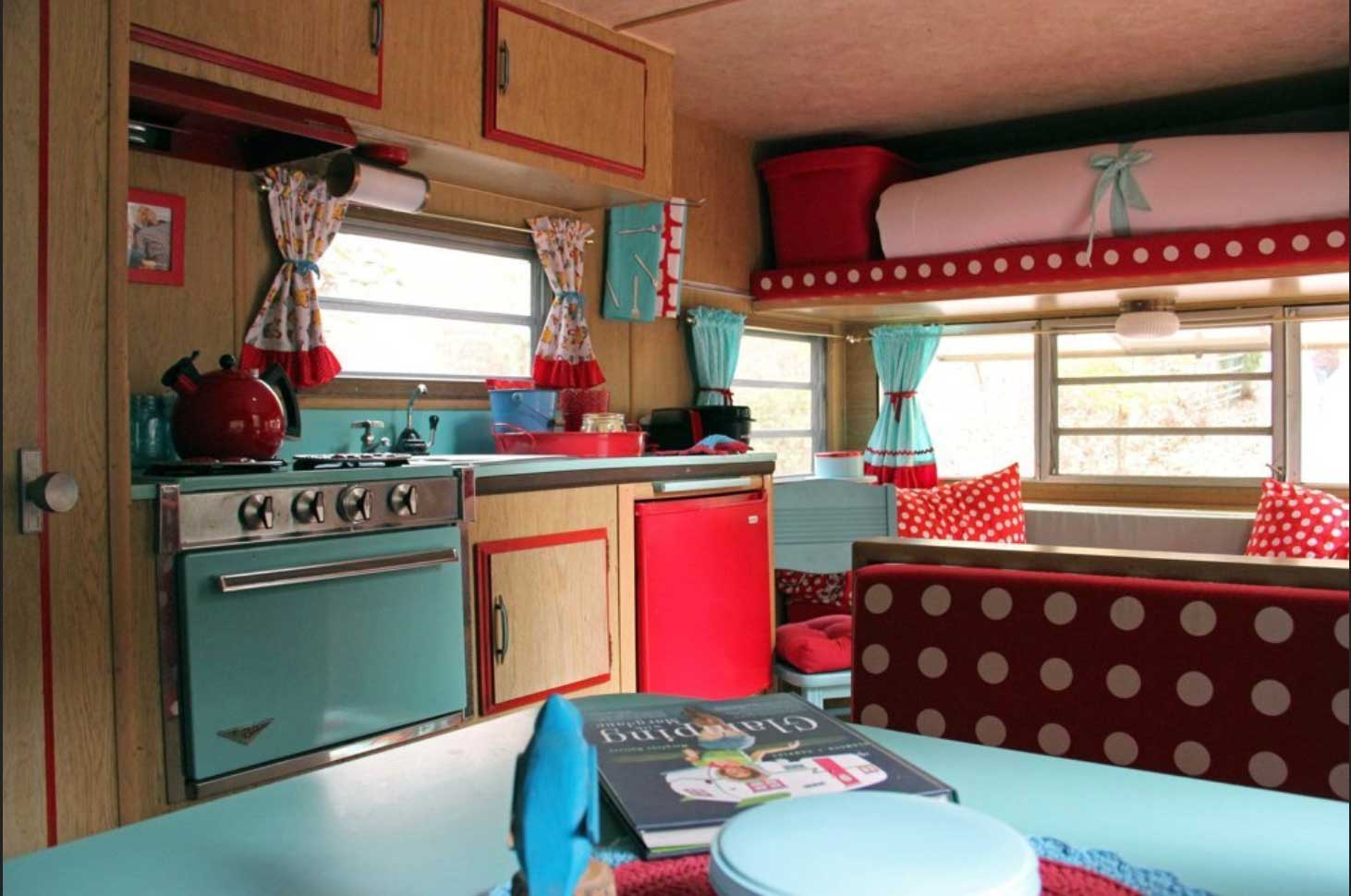
interior of their 1970s camper trailer

Interior of their 1970s camper trailer

These owners amped up the adorable factor on the interior of their 1970s camper trailer. (image courtesy of countryliving.com)

Living a life off the grid

Of course, there are people who toss aside life in a conventional apartment or house and instead opt to live in their camper or RV full time. A retired person who makes the choice to live in an RV as his or her primary residence is referred to in Australia as a “grey nomad.” According to a November 2018 article in The Washington Post, an estimated 1 million people live full-time in their RV.

From the article: “We’re a family of four redefining what the American Dream means. It’s happiness, not a four-bedroom house with a two-car garage,” said Robert Meinhofer, 45, who lives in an RV with wife Jessica and their two children.

Another couple, Steven and Joyce Seid, originally from Wichita, KS, traverses the country in their RV during the warmer months of the year. Joyce has decorated the interior with big, beautiful sunflowers, a colorful reminder of Kansas.

“This is a great life,” Steven said in the Washington Post article. “We meet the nicest people.”

Despite the trend of retirees deciding to live in RVs full-time, the RV Industry Association says that half of new RV sales are going to buyers younger than 45, and nearly 11 million households own at least one RV.

Tin Can Tourists

Though modern campers and RVs continue their rise in popularity, the Tin Can Tourists group was founded in 1998 and still has various regional rallies throughout the U.S. In cyberspace, Heintz and the group’s other members post photos of elongated travel trailers, some as long as 50 feet. They also share the original owners’ manuals for their camper or trailer, as well as advertisements and other related ephemera.

“My family also has a very long history of pulling such large trailers as full-timers from the 1940s to the 1970s,” Heintz writes. “I still own the pink and white 1958 Skyline (8’x45’) that my parents purchased brand-new in late 1957.”

Shasta Camper

Shasta Camper

Shasta, originally one of the biggest names in the camper industry, advertised its campers in a way to bring families together in the great outdoors. (Image courtesy of vintagecampertrailers.com)

Restored Camper Trailer

Restored Camper Trailer

This shining example of a restored camper trailer was featured in Camper Report magazine. (Image courtesy of camperreport.com)

Purchase the trailer of your dreams (or at least look at it)

The Tin Can Tourists website also features a classified ad section, where sellers can advertise vintage trailers for sale. The latest offerings in the classifieds section include a 1968 Road Runner ($18,200), a 1961 Shasta Airflyte 16SC vintage trailer ($15,000), and a 1952 16-foot Pleasurecraft ($14,500).

If those beauties are a bit out of your price range, you can at least see many on display this summer in our coverage region. In Leasburg, MO, the 2022 Missouri Loves Company Vintage Camper Rally will take place June 2-5 at the Ozark Outdoors Resort (for more information, call 573-245-6837). This is the first year for this particular rally. In Arkansas, the 72 West Vintage Camper Show (at 11507 West Highway 72 in Centerton) will be held June 11 and will include a contest, with entrants vying for best interior, best exterior, and best in show trophies (call 479-206-2491 for more information).


Campers and restoration projects

Campers and restoration projects

Campers proudly share their campers and restoration projects with others on Facebook. (Image courtesy of Vintage Camper Trailers FB group)

Keeping your treasured camper in good repair

Just like any home, whether it’s tethered to a foundation or on wheels, some of the more common repairs and preventative maintenance for vintage trailers will include asbestos removal. Moisture and condensation also pose dual problems to maintaining a clean mobile living space, with water vapor specifically created by the drying of clothes and the cooking of food having the potential to wreak havoc on the camper’s interior.

Tin Can Tourists recommends proper ventilation of one’s camper, and doing everything you can to lower the humidity inside.
Tin Can Enthusiasts identifies asbestos as a potentially deadly problem for anyone restoring a vintage camper.

“There are numerous items that can contain asbestos in vintage trailers,” according to the group’s website. “Some of these materials include insulation, vinyl tile, and brake linings. If you have a vintage RV, there are several car parts that could contain asbestos as well. Some parts such as the hood liner, various gaskets and clutch plates could have been made with asbestos.”

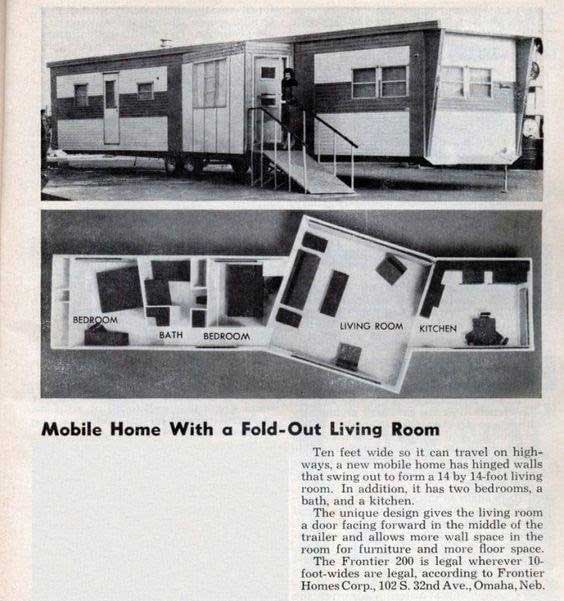
1961 Frontier Trailer

1961 Frontier Trailer

Advertisement for a 1961 Frontier Trailer, which featured a “fold-out living room.” (Image courtesy of Heintz Designs)

Nostalgia on wheels

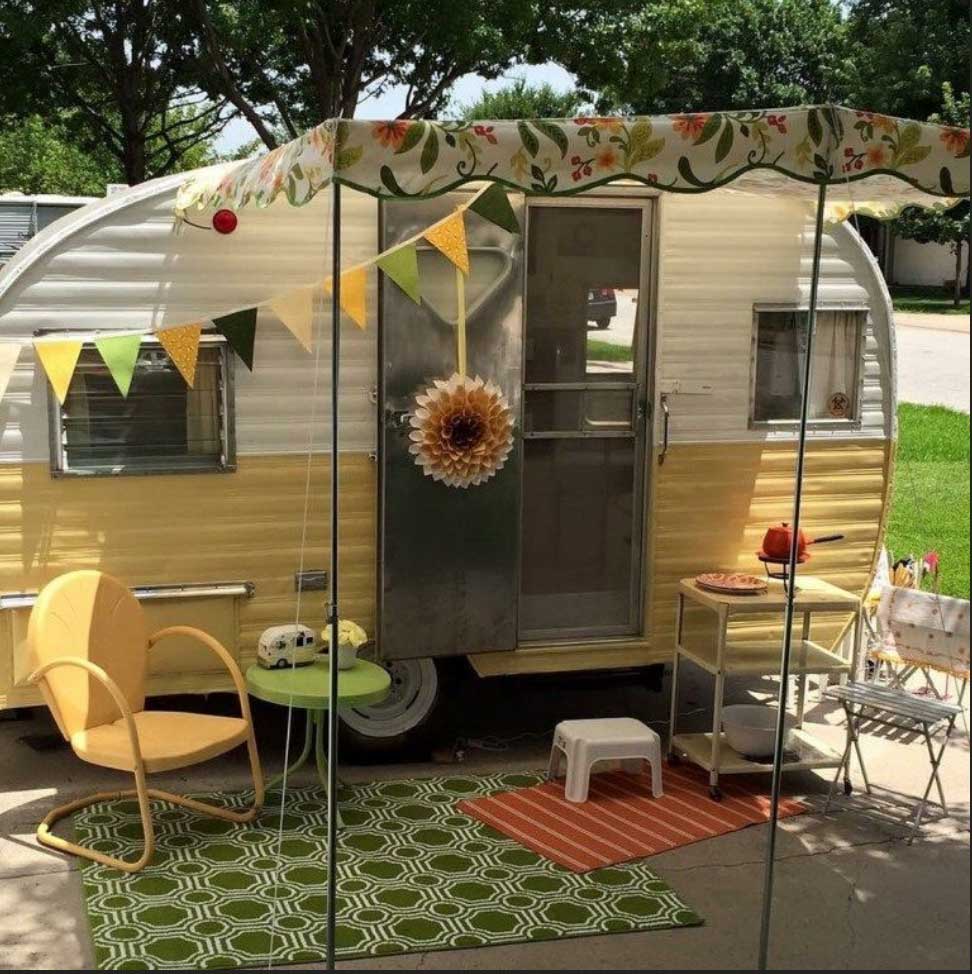
No matter the type of vintage camper or the decade in which it was manufactured, the important thing is to get out this summer and enjoy yourself with your own personal style. Vintage camper owners know their aluminum treasure will always attract onlookers with plenty of questions, comments and exclamations.

“Vintage trailers are an excellent way to connect to the past while enjoying the great outdoors,” the Tin Can Tourists blog states. “One might be drawn to vintage trailers because of memories camping with their family in an Airstream or traveling to see the national parks, toting a trailer behind the family station wagon. Vintage travel trailers are packed so full of charm and classic features that often evoke nostalgia. No matter the reason, that vintage, polished aluminum Airstream is certain to turn heads cruising into a state park for the weekend.”

For more information on vintage campers and the history of travel trailers, or to join the organization itself, visit the Tin Can Toursists’ website at www.tincantourists.com.

Retro cool

Retro cool

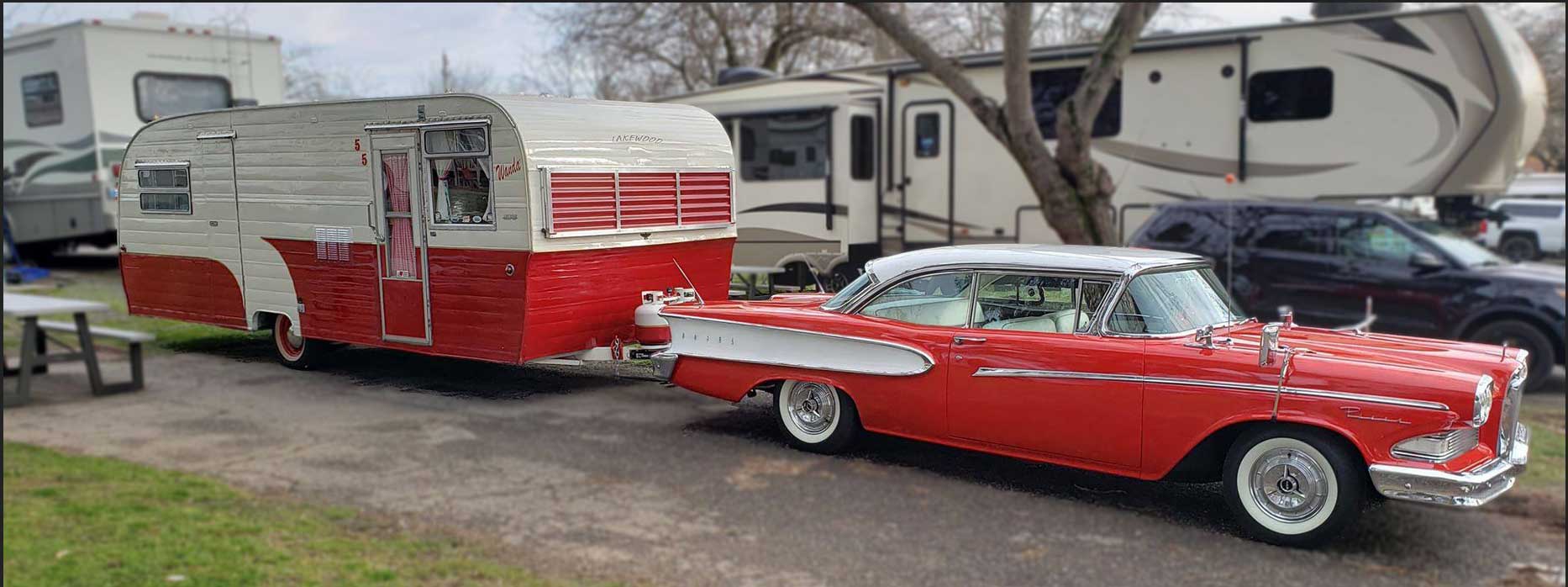
Retro cool - having a matching car to pull your trailier adds a real WOW factor. (Image courtesy of vintagecampertrailers.com)